








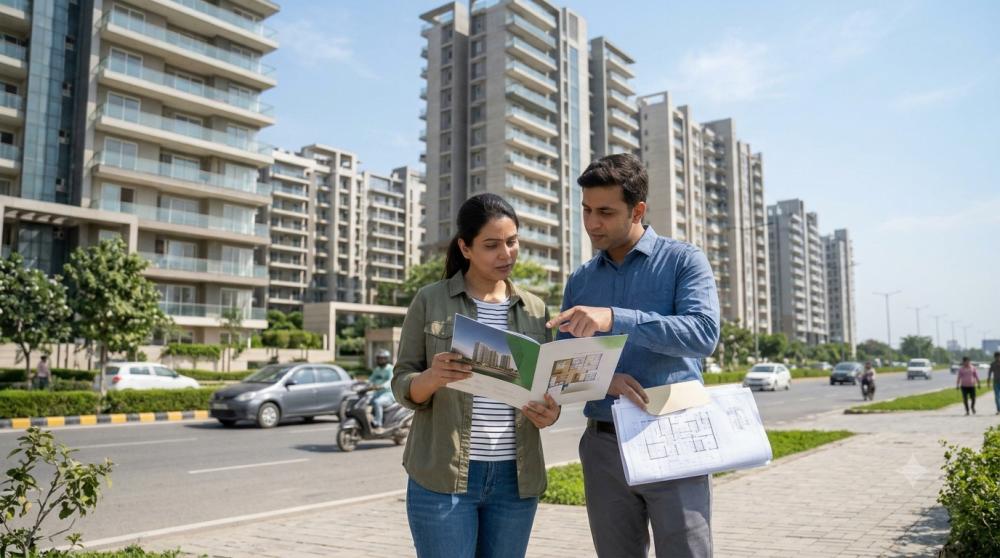
What Should You Check Before Buying a New Home on Dwarka Expressway?

Buying a new home is exciting, but it is also one of the biggest financial decisions most people make. When a location is developing quickly and attracting new residential projects, the number of choices can make the process even more confusing.
Dwarka Expressway is one such market. The corridor has developed from an emerging residential location into a major housing destination connecting Delhi and Gurugram. Better road connectivity, new residential communities, improving social infrastructure, and interest from homebuyers and investors have all contributed to its growing importance.
Recent market reports show that residential prices along the corridor have increased significantly since 2021. Anarock data reported in September 2026 placed the average residential price at around ₹14,180 per sq. ft. in H1 2026, compared with approximately ₹6,032 per sq. ft. in 2021. The market has also seen substantial new housing supply and increasing rental activity.
But a growing market does not mean every property is automatically the right choice.
If you are thinking about buying a home here, the most useful approach is to slow down, compare your options, and understand what you are actually paying for.
Here is a practical guide to the things you should check before making your decision.
1. Start With Your Reason for Buying
Before visiting properties, ask yourself one simple question:
Why am I buying this home?
Your answer can change the way you evaluate everything else.
If you are buying for your own family, your priorities may include commute time, schools, hospitals, shopping, apartment layout, neighborhood environment, and everyday convenience.
If you are buying as an investment, you may focus more on future demand, rental potential, resale prospects, location development, and the relationship between the purchase price and potential returns.
If you expect to move into the property several years from now, you may have yet another set of priorities.
There is no single checklist that works equally well for everyone.
The first step is therefore to define your purpose.
2. Understand the Location Instead of Just the Project
A property advertisement usually focuses heavily on the building.
You will see pictures of the entrance, clubhouse, swimming pool, landscaped areas, apartment interiors, and other facilities.
However, your actual experience will also depend on everything outside the project.
Look at the surrounding roads.
Check the distance to major routes.
Find out how long it takes to reach your workplace during normal working hours.
Look at nearby schools, healthcare facilities, supermarkets, restaurants, parks, and public transportation.
It is also useful to visit the area during different times of the day.
A location can look peaceful in the afternoon but become much busier during peak commuting hours.
Similarly, a route that appears short on a map may take considerably longer because of local traffic or road conditions.
The neighborhood deserves just as much attention as the apartment itself.
3. Don't Assume Every New Project Offers the Same Value
The growing number of New projects on Dwarka Expressway gives buyers more choice, but it also makes comparison more important.
Different developments can vary significantly in terms of:
-
Apartment sizes
-
Construction stage
-
Developer experience
-
Location
-
Amenities
-
Maintenance costs
-
Parking arrangements
-
Possession timeline
-
Project density
-
Surrounding development
-
Pricing
A project with a large clubhouse may look attractive, but that does not automatically make it better than another project with fewer amenities and a more convenient location.
Similarly, a larger apartment may not necessarily provide better value if the additional space is not useful to your family.
Try to compare properties based on your actual requirements rather than the number of features shown in a brochure.
4. Check the Developer's Track Record
The developer behind a project can have a major influence on your ownership experience.
Before making a decision, research previous projects by the developer.
Look for information about:
-
Delivery history
-
Construction quality
-
Maintenance
-
Customer experiences
-
Project completion
-
Post-possession services
-
Transparency in documentation
Do not depend entirely on promotional material.
Try to collect information from multiple sources and, where possible, speak with people who already live in the developer's completed communities.
This can give you a much better understanding of what ownership may actually be like.
5. Verify the Project's Legal and Regulatory Information
A property purchase involves much more than selecting a floor and signing a booking form.
Before committing a significant amount of money, buyers should carefully verify applicable project registration, approvals, ownership-related documents, agreements, payment schedules, and other relevant paperwork.
For an under-construction project, pay particular attention to the expected completion and possession terms.
If you do not understand a document, ask a qualified property lawyer or other appropriate professional to review it.
A few hours spent understanding documentation can prevent much bigger problems later.
6. Look at the Actual Cost, Not Just the Advertised Price
One of the most common mistakes buyers make is focusing only on the base price.
The final cost can include several additional expenses.
Depending on the project and transaction, these may include:
-
Registration charges
-
Stamp duty
-
Parking charges
-
Club or facility charges
-
Maintenance deposits
-
Utility-related costs
-
Interior work
-
Loan processing costs
-
Insurance
-
Other applicable fees
Ask for a complete cost sheet before making a financial commitment.
This will help you understand whether the property is genuinely affordable.
A home that fits your budget comfortably is generally a safer choice than a property that requires you to stretch your finances to the limit.
7. Compare Apartment Layouts Carefully
Two apartments with the same number of bedrooms can feel completely different.
Look at the actual usable space rather than focusing only on the total area.
Ask:
-
Is the living room practical?
-
Are the bedrooms appropriately sized?
-
Is there enough storage?
-
Does the kitchen have useful space?
-
Is there sufficient natural light?
-
Is ventilation adequate?
-
How much space is lost to passages?
-
Does the balcony serve a practical purpose?
If possible, visit a sample apartment and understand the actual dimensions.
A well-designed smaller apartment can sometimes feel more comfortable than a larger apartment with an inefficient layout.
8. Check Light, Ventilation and Orientation
These factors are easy to overlook when buyers are focused on price and amenities.
Natural light can make an apartment feel more spacious and comfortable.
Good ventilation can improve the everyday living environment.
Also consider the view from the apartment, surrounding buildings, privacy, noise levels, and the direction in which rooms face.
If you are buying an apartment that will be your home for many years, these details can matter much more than a decorative feature in the clubhouse.
9. Think About Your Daily Commute
Connectivity is one of the major reasons buyers consider Dwarka Expressway.
The corridor has become increasingly important for movement between Delhi and Gurugram, and infrastructure improvements have strengthened its residential appeal. Current market research also links improving connectivity and social infrastructure with rental and housing demand along the corridor.
But don't judge connectivity only from a presentation.
Actually test your likely route.
If you work in Gurugram, check the commute toward your office.
If your family regularly travels toward Delhi, check the opposite direction.
If airport access matters to you, calculate the practical journey rather than relying on a general statement such as "close to the airport."
The best location is the one that makes your actual routine easier.
10. Consider Future Infrastructure Carefully
Infrastructure can have a major influence on real estate markets.
The Dwarka Expressway corridor has benefited from major road connectivity, while additional transportation and urban infrastructure continues to be planned and developed in the wider Gurugram region.
For example, the Union Cabinet previously approved the Gurugram metro corridor from HUDA City Centre toward Cyber City with a spur toward Dwarka Expressway.
There are also ongoing road infrastructure initiatives in Gurugram intended to strengthen connections between major corridors.
However, buyers should make an important distinction:
Existing infrastructure and proposed infrastructure are not the same thing.
Do not pay a premium solely because someone promises that a future project will transform the location.
Verify the status of major infrastructure plans through reliable sources and evaluate the property based on what is already available as well.
11. Think About Rental Demand Even If You Are an End User
Your current plan may be to live in the property, but circumstances can change.
You may relocate for work.
Your family may grow.
You may eventually upgrade to another home.
You may decide to rent out the property.
For that reason, understanding rental demand can still be useful.
Recent market reporting indicates that rental values on Dwarka Expressway rose strongly in H1 2026, with Business Today citing Savills data showing 22% year-on-year rental growth.
But rental performance varies between projects.
A practical rental assessment should consider apartment size, furnishing, building quality, amenities, location, parking, nearby employment hubs, and maintenance costs.
Never assume that one project's rental rate automatically applies to another.
12. Compare the Location With Established Residential Areas
A good property decision often becomes easier when you compare a new residential corridor with established neighborhoods.
For example, someone researching Paryavaran Complex flats for rent may prioritize an established South Delhi environment, existing local services, and convenient access to familiar areas.
Another person searching for Flats for rent in Malviya Nagar may be more concerned about immediate access to markets, transportation, educational institutions, workplaces, and everyday services.
These comparisons can help a Dwarka Expressway buyer understand what they are gaining and what they may be giving up.
A newer residential corridor may offer modern buildings, larger communities, newer amenities, and developing infrastructure.
An established locality may offer mature social infrastructure and a neighborhood that has already developed around residents' daily needs.
Neither is automatically better.
It depends on your lifestyle.
13. Don't Ignore the Resale Question
Even if you are not buying specifically as an investor, it is worth considering how easily the property could be sold in the future.
Ask yourself:
If I had to sell this property five years from now, who would want to buy it?
The answer can help you evaluate the property's broader appeal.
Factors that may influence future resale interest include:
-
Location
-
Developer reputation
-
Apartment size
-
Layout
-
Building condition
-
Maintenance
-
Connectivity
-
Parking
-
Surrounding development
-
Overall market demand
A property that appeals to a broad range of buyers may provide more flexibility than one designed for a very narrow audience.
14. Understand the Difference Between Price and Value
A higher-priced property is not automatically more valuable.
Likewise, a cheaper property is not necessarily a bargain.
Value depends on what you receive in return for the money you spend.
Consider a hypothetical comparison.
Property A costs less but is far from important daily destinations and has higher ongoing expenses.
Property B costs more but offers a better commute, practical layout, reliable construction, and stronger everyday convenience.
The second property may provide better value for a particular buyer even though its initial price is higher.
This is why comparing price per square foot alone is not enough.
Look at the complete ownership experience.
15. Consider the Total Lifestyle
A home is not just an investment certificate.
You will wake up there.
You will commute from there.
Your children may study nearby.
You will shop for groceries, visit doctors, meet friends, and spend your weekends around the neighborhood.
Think about what a normal Tuesday would look like after moving there.
How long would your morning commute take?
Where would you buy everyday essentials?
How far is the nearest healthcare facility?
Where would your family spend free time?
Would the neighborhood still suit you after five years?
These questions make property research more personal and practical.
16. Make a Shortlist Instead of Visiting Everything
You do not need to visit every project in the market.
Start by creating a shortlist of three to five properties.
For each one, record:
| Factor | Property 1 | Property 2 | Property 3 |
|---|---|---|---|
| Location | |||
| Total Cost | |||
| Apartment Size | |||
| Layout | |||
| Developer | |||
| Construction Status | |||
| Connectivity | |||
| Amenities | |||
| Maintenance | |||
| Documentation | |||
| Rental Potential | |||
| Resale Potential |
This makes your decision less emotional.
Instead of remembering which salesperson said what, you will have an actual comparison.
17. Ask Questions During the Site Visit
Don't simply walk through the sample apartment and leave.
Ask practical questions.
About the Project
-
When is possession expected?
-
What is the current construction status?
-
What facilities are operational?
-
What are the maintenance expectations?
About the Apartment
-
What is the usable area?
-
What is included in the quoted price?
-
Is parking included?
-
What are the available configurations?
About Documentation
-
What project registration information is available?
-
What approvals have been obtained?
-
What documents should the buyer review?
About the Neighborhood
-
What facilities are currently operational nearby?
-
What transportation options are available?
-
Which roads provide the easiest access?
Good questions often reveal more than a polished presentation.
Frequently Asked Questions
Is Dwarka Expressway a suitable location for a new home?
It can be suitable for buyers who value Delhi-Gurugram connectivity, newer residential communities, improving infrastructure, and access to a growing residential ecosystem. The right project still depends on budget, location, documentation, and personal requirements.
Are new properties on the corridor suitable for families?
Many projects are designed around family-oriented housing, particularly larger apartments and integrated communities. Families should still evaluate schools, healthcare, commuting time, open spaces, safety, and everyday services before choosing a particular development.
Should buyers wait for prices to become lower?
There is no reliable way to predict the exact future direction of property prices. Instead of waiting solely for a particular price target, buyers should evaluate affordability, project quality, location, and their own time horizon.
Is buying a property here only useful for investors?
No. The corridor has attracted both investors and end users. Recent market reports indicate strong demand for completed homes, premium housing, and rentals, which suggests that the market serves different types of buyers.
How important is the developer's reputation?
Very important. A developer's previous delivery record, construction quality, documentation practices, and post-possession service can influence the overall ownership experience.
Should future infrastructure influence my buying decision?
It can be one factor, but it should not be the only reason to buy. Give greater weight to infrastructure that already exists and verify the status of future projects through reliable sources.
Final Thoughts
Buying a home on Dwarka Expressway in 2026 can be an interesting opportunity, but the decision should be based on much more than the popularity of the location.
The corridor has experienced substantial development, strong housing demand, significant price appreciation, and growing rental activity. At the same time, the market contains a wide variety of projects, and each one needs to be evaluated individually.
The smartest approach is to begin with your own needs.
Understand your budget.
Study the location.
Compare projects.
Inspect the apartment carefully.
Research the developer.
Verify the documentation.
Calculate the complete ownership cost.
And don't forget to evaluate what everyday life in the neighborhood will actually feel like.
You may also find it useful to compare your shortlisted property with established rental markets. People considering Flats for rent in South Delhi, for example, may place greater importance on mature neighborhood facilities, while a buyer on Dwarka Expressway may prioritize newer construction and developing connectivity.
Likewise, someone evaluating Dwarka Expressway property investment should consider rental demand, future liquidity, project quality, and purchase price rather than assuming that every property will deliver the same return.
Ultimately, the right home is not necessarily the newest, biggest, or most expensive one.
It is the property that fits your finances, your routine, your family, and your long-term plans.
Take your time, verify the facts, and choose based on the complete picture rather than the excitement surrounding a growing market.


