








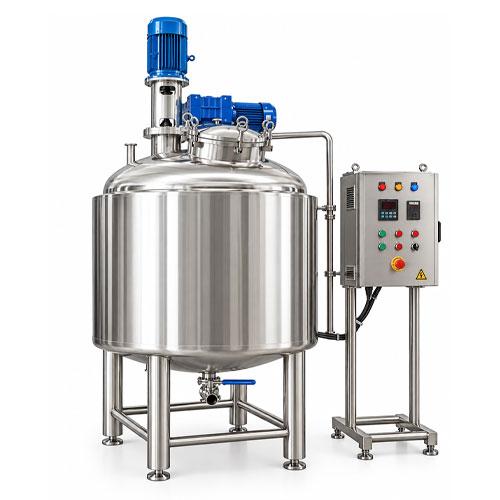
Edible Oil Mixing Tank: Working Principle, Design, Types, and Applications

An edible oil mixing tank is a processing vessel used in the food industry to blend, homogenize, and prepare edible oils with other ingredients. It plays an important role in the production of cooking oil blends, sunflower oil, soybean oil, palm oil, groundnut oil, mustard oil, and specialty food-grade oil products.
These tanks are designed to provide uniform mixing while maintaining product quality, hygiene, and process efficiency. Depending on the application, an edible oil mixing tank may include an agitator, heating arrangement, temperature monitoring system, and controlled inlet and outlet connections.
Edible oil mixing tanks are widely used in vegetable oil processing plants, food manufacturing facilities, oil refineries, and edible oil packaging industries.
1. What Is an Edible Oil Mixing Tank?
An edible oil mixing tank is a stainless steel vessel designed to combine two or more oil components or mix oil with suitable food-grade ingredients. The tank uses a mechanical agitator to circulate the liquid and distribute the components throughout the vessel.
For example, a manufacturer may use a mixing tank to blend sunflower oil with soybean oil in a specific ratio to achieve the desired product characteristics.
Depending on the formulation, the tank can also be used for mixing oil-soluble additives, permitted antioxidants, flavors, or other approved ingredients.
The tank capacity may range from a few hundred liters for small production facilities to several thousand liters or more for industrial processing plants.
2. Working Principle of an Edible Oil Mixing Tank
The working principle is based on mechanical agitation and liquid circulation. An electric motor drives a shaft fitted with an impeller or other suitable mixing element. The rotating impeller creates liquid movement inside the vessel, helping distribute different oil components evenly.
The typical operating process includes the following steps:
- Loading of oil: The required quantity of base oil is transferred into the tank through an inlet or transfer pipeline.
- Ingredient addition: Other oil components or approved additives are added according to the formulation.
- Agitation: The motor-driven agitator circulates the liquid and promotes uniform blending.
- Temperature control: If necessary, the oil is heated using a suitable heating system to reduce viscosity and improve flow and mixing.
- Mixing completion: The batch is mixed for the validated time until the required uniformity is achieved.
- Quality inspection: The product is checked against applicable quality parameters, such as blend composition, temperature, and other formulation requirements.
- Discharge: The finished oil is transferred through the bottom outlet to a storage tank, filtration system, or filling line.
The actual mixing time and operating speed depend on the oil viscosity, batch size, impeller design, and number of components being blended.
3. Main Components of an Edible Oil Mixing Tank
1. Mixing Vessel: The main container holds the edible oil during processing. It is commonly manufactured from food-contact-compatible stainless steel, with SS304 and SS316 selected according to product composition, cleaning requirements, and corrosion considerations.
2. Agitator and Drive System: The agitator consists of an electric motor, gearbox where required, shaft, and impeller. It generates circulation inside the tank and helps blend different oil components.
3. Impeller or Mixing Blade: A propeller, pitched-blade turbine, or another suitable impeller may be selected according to the tank geometry, viscosity, and required circulation pattern.
4. Heating System (Optional): A heating jacket or another suitable indirect heating arrangement can help maintain the required processing temperature. Heating is particularly useful when the oil becomes viscous at lower temperatures.
5. Outlet and Drain Connection: A properly sized outlet valve allows the finished oil to be transferred to downstream equipment. The outlet design should minimize product retention and facilitate cleaning.
4. Types of Agitators Used for Edible Oil Mixing
The selection of an agitator is important because different impellers produce different circulation patterns.
|
Agitator type |
Main function |
Typical application |
|
Propeller agitator |
Produces strong axial circulation |
Low-viscosity oil blending |
|
Pitched-blade turbine |
Provides axial and radial flow |
General-purpose oil mixing |
|
Paddle agitator |
Provides relatively gentle bulk movement |
Simple blending applications |
|
Anchor agitator |
Sweeps near the vessel wall |
Higher-viscosity products or wall-sweeping duties |
|
High-shear mixer |
Produces intense localized shear |
Specialized formulations requiring dispersion or emulsification |
For ordinary blending of two low-viscosity edible oils, a properly sized propeller or pitched-blade agitator is often a practical starting point.
An anchor agitator is not normally necessary for simple, low-viscosity oil blending. A high-shear mixer is generally considered when the formulation requires more intensive dispersion or when separate phases must be emulsified. The appropriate arrangement must be determined from the actual process requirements.
5. Materials of Construction
Material selection is essential for food safety, durability, and ease of cleaning.
|
Component |
Common material or specification |
|
Tank shell |
SS304 or SS316 stainless steel |
|
Bottom and top cover |
Food-contact-compatible stainless steel |
|
Agitator shaft |
SS304 or SS316, selected for service conditions |
|
Impeller |
SS304 or SS316 |
|
Product-contact fittings |
Suitable stainless steel |
|
Gaskets and seals |
Food-contact-compliant material compatible with the oil and cleaning agents |
|
External support structure |
Stainless steel or suitably protected structural steel |
SS304 is widely used for many edible oil applications. SS316 may be preferred where improved corrosion resistance is needed, depending on the formulation and cleaning chemicals.
The final selection should consider food-contact requirements, corrosion resistance, surface finish, temperature, and applicable regulations.
6. Importance of Temperature Control
Temperature can influence the viscosity, flow behavior, and mixing performance of edible oils.
When oil temperature decreases, its viscosity may increase, making circulation and pumping more difficult. Some oils, particularly those containing higher proportions of saturated fats, may also become cloudy or partially solidify under cooler conditions.
A controlled heating system may therefore be useful for:
- Maintaining a suitable processing temperature.
- Improving flow during transfer and blending.
- Helping manage viscosity variations.
- Supporting the processing requirements of oils that become cloudy or partially solid at lower temperatures.
Heating should be controlled carefully to avoid unnecessary thermal exposure, oxidation, or degradation of the oil. The correct operating temperature depends on the oil type and product specification.
7. Applications of Edible Oil Mixing Tanks
Vegetable Oil Blending: Blending sunflower, soybean, palm, canola, groundnut, or other edible oils to achieve a specified composition and product profile.
Edible Oil Processing Plants: Preparing batches for subsequent processing, filtration, quality inspection, and transfer to storage or packaging systems.
Cooking Oil Manufacturing: Producing consistent batches of blended cooking oil for commercial and retail applications.
Food Ingredient Preparation: Mixing approved oil-soluble ingredients into oil-based food formulations where the process and formulation permit.
8. Hygienic Design and Cleaning
Since edible oil is a food product, the tank should be designed to support hygienic processing and prevent contamination.
Important considerations include:
- Smooth product-contact surfaces with a suitable finish.
- Properly designed welds and product-contact joints.
- Suitable seals and gaskets.
- A drainable vessel bottom and appropriately positioned outlet.
- A cleaning procedure compatible with the product and equipment materials.
- Prevention of cross-contamination between different oil formulations.
- Suitable inspection and maintenance access.
Depending on the application, cleaning may be performed manually or with a clean-in-place (CIP) system. The cleaning method must be validated for the actual product and process; a CIP arrangement should not be assumed to clean every tank design effectively without verification.
9. Factors to Consider When Selecting an Edible Oil Mixing Tank
Before selecting or designing a tank, the following parameters should be evaluated.
|
Parameter |
Why it matters |
|
Working capacity |
Determines the required batch volume and available headspace |
|
Oil type |
Influences viscosity, temperature requirements, and material compatibility |
|
Number of ingredients |
Helps determine the required mixing performance |
|
Agitator speed |
Affects circulation, blending time, and power consumption |
|
Motor power |
Must be suitable for the impeller, tank geometry, and fluid properties |
|
Heating requirement |
Depends on oil viscosity and operating conditions |
|
Tank geometry |
Influences circulation and the possibility of stagnant zones |
|
Cleaning method |
Determines vessel finish, drainage, fittings, and cleaning provisions |
|
Discharge arrangement |
Must suit the downstream pump, filter, storage tank, or filling line |
|
Instrumentation |
May include temperature sensors, level indicators, and speed controls |
The motor power and impeller diameter should be selected through engineering calculations and, where necessary, practical trials. Tank capacity alone is not sufficient to determine the correct agitator or motor size.
10. Maintenance and Operating Best Practices
Routine maintenance helps maintain mixing performance and equipment reliability.
- Inspect the agitator shaft, impeller, couplings, and mechanical seals.
- Check the motor and gearbox for abnormal noise, vibration, or overheating.
- Verify temperature sensors and speed controls where installed.
- Follow the approved cleaning procedure after production or product changeover.
- Inspect product-contact surfaces for corrosion, deposits, and damage.
- Confirm that valves and outlet connections operate correctly.
- Maintain records of operating conditions, cleaning, inspection, and repairs.
Operators should follow the equipment manufacturer's instructions and applicable workplace safety procedures. Before opening or servicing the tank, isolate the power supply and ensure the agitator cannot start unexpectedly.
An edible oil mixing tank is an important piece of equipment for achieving consistent blending, maintaining product quality, and improving the efficiency of edible oil manufacturing. Its performance depends on the correct selection of vessel material, agitator type, motor power, operating speed, temperature control, and hygienic design.
For simple blending of low-viscosity edible oils, a stainless-steel tank with a suitably designed propeller or pitched-blade agitator may be sufficient. More specialized formulations may require additional heating, dispersion, or process-control equipment.
The key principle is to design the mixing system around the actual oil formulation and processing requirements rather than selecting equipment based on tank capacity alone.


