








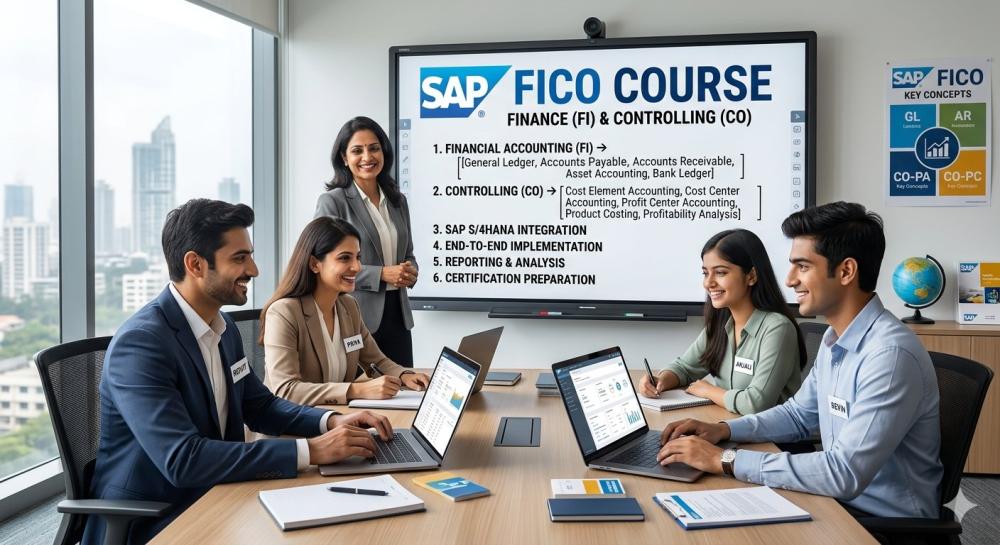
Learn SAP FICO Course 2027: Eligibility, Syllabus, Salary & Scope

SAP FICO combines Financial Accounting (FI) and Controlling (CO), the SAP modules that run a company’s books, costing, and reporting. To learn it, you need basic accounting knowledge, 3-5 months of structured practice on an SAP S/4HANA system, and hands-on work with real business scenarios. Commerce graduates, CAs, and finance professionals are the most common learners.
What Is SAP FICO?
SAP FICO is a pair of modules inside SAP’s ERP software:
- FI (Financial Accounting): general ledger, accounts payable, accounts receivable, asset accounting, bank accounting, and financial statements.
- CO (Controlling): cost centers, profit centers, internal orders, product costing, and profitability analysis.
FI reports what happened to the money, mainly for external stakeholders such as auditors and regulators. CO explains where the money went inside the business, for managers making decisions.
Why SAP FICO Still Matters in 2027
SAP has announced that mainstream maintenance for ECC 6.0 ends in 2027, with optional paid extended maintenance beyond that. Verify the current dates on SAP’s official site, as they can change. In practice, many companies are migrating to S/4HANA, and that migration needs consultants who understand both finance and the new system.
If you start learning now, focus on S/4HANA rather than older ECC-only material. S/4HANA changes how finance works, including the Universal Journal, the Business Partner model, and simplified reporting.
Who Is Eligible to Learn SAP FICO?
SAP does not set a strict eligibility rule for learning, but these backgrounds make it much easier:
- B.Com, M.Com, BBA, MBA (Finance) graduates
- Learn SAP FICO Course
- Chartered Accountants, CMAs, and CS professionals
- Working accountants and finance executives
- Auditors and financial analysts
- IT professionals moving into finance-focused ERP roles
Prerequisite knowledge:
- Debits, credits, and journal entries
- Balance sheet and profit-and-loss basics
- Basic cost accounting concepts
- Comfort with Excel
If you have no accounting background, spend 3-4 weeks on fundamentals first. Skipping this step is the most common reason beginners struggle.
SAP FICO Syllabus (Typical Course Structure)
Training providers vary, but a solid S/4HANA-focused course usually covers the following:
| Module Area | Key Topics |
|---|---|
| Enterprise Structure | Company code, chart of accounts, fiscal year variant, controlling area |
| General Ledger (GL) | Master data, posting, parked documents, recurring entries, period-end closing |
| Accounts Payable (AP) | Vendor master via Business Partner, invoices, payment runs, down payments |
| Accounts Receivable (AR) | Customer invoicing, incoming payments, dunning, credit management basics |
| Asset Accounting | Asset classes, depreciation areas, acquisition, retirement, depreciation run |
| Bank Accounting | Bank master data, electronic bank statements, reconciliation |
| Controlling (CO) | Cost elements, cost centers, internal orders, allocations, profit centers |
| Product Costing | Cost estimates, material ledger basics, variance analysis |
| Integration | Links with MM (procurement), SD (sales), and PP (production) |
| S/4HANA Essentials | Universal Journal, simplified data model, Fiori apps for finance |
How to Learn SAP FICO: A Step-by-Step Roadmap
- Refresh your accounting fundamentals. Make sure you can read a trial balance without hesitation.
- Understand the SAP landscape. Learn what ERP means and how FI and CO connect to other modules.
- Learn the enterprise structure. Every configuration step depends on it.
- Practice FI sub-modules in order. Start with GL, then AP, AR, and Asset Accounting.
- Move to CO. Learn cost center accounting first, then allocations and product costing.
- Work on a mini-project. For example, set up a fictional company, post a month of transactions, and run closing.
- Prepare for certification. Check SAP’s official certification catalog for the current finance exam codes.
- Build a resume with practical scenarios. Employers want to see what you have configured or analyzed, not just a course certificate.
Realistic timeline: most learners need 3-5 months with consistent practice. Full job readiness often takes longer, because real projects involve messy data and unfamiliar business rules.
Skills You Need Beyond the Software
- Strong accounting logic and attention to detail
- Ability to document requirements clearly
- Communication with business users who are not technical
- Basic understanding of taxation and compliance in your region
- Problem-solving during month-end and year-end closing
SAP FICO Career Scope in 2027
Common roles include:
- SAP FICO Consultant
- SAP Finance Analyst
- SAP Functional Support Executive
- S/4HANA Finance Migration Consultant
- Business Process Owner (Finance)
- SAP Finance Project Lead (with experience)
Where the demand comes from:
- Companies migrating from ECC to S/4HANA
- Global business services and shared service centers
- IT consulting and implementation firms
- Manufacturing, retail, banking, and pharma companies running SAP
- How To Learn Korean Language
SAP FICO Salary: What Affects Your Pay
Salary figures change quickly by country, city, and year, so check current listings on job portals rather than relying on a fixed number. These factors have the biggest effect:
| Factor | Effect on Pay |
|---|---|
| Years of hands-on experience | Strongest factor |
| S/4HANA project experience | Often a premium over ECC-only profiles |
| Domain background (CA, CMA, MBA) | Helps in senior and functional roles |
| Implementation vs. support experience | Implementation is usually valued more |
| Location and employer type | Consulting firms, product companies, and in-house roles differ |
| Certifications and specializations | Helpful, but secondary to project proof |
Common Mistakes to Avoid
- Learning only theory with no system access
- Memorizing T-codes without understanding the accounting behind them
- Studying outdated ECC-only content
- Ignoring integration with MM and SD, which are heavily tested in interviews
- Expecting a certificate alone to guarantee a job
Practical Example: A Purchase-to-Pay Scenario
A company buys raw material for 100,000 and later pays the vendor:
- Goods receipt posts to inventory and a clearing account (MM integration).
- The vendor invoice posts to the vendor account (AP).
- The payment run clears the vendor liability and credits the bank (FI).
- Cost allocations to the correct cost object are handled in CO.
Being able to explain this flow end to end is exactly what interviewers look for.
Frequently Asked Questions
1. What is the SAP FICO course?
It is training in SAP’s Financial Accounting (FI) and Controlling (CO) modules, covering ledgers, payables, receivables, assets, cost centers, and financial reporting.
2. Can a non-commerce student learn SAP FICO?
Yes, but you must first learn accounting basics. Without them, configuration and closing processes are hard to follow.
3. How long does it take to learn SAP FICO?
Most people need about 3-5 months of regular study and practice. Job readiness depends on hands-on exposure.
4. Is SAP FICO still worth learning in 2027?
Yes, particularly S/4HANA finance skills, because many organizations are still migrating or optimizing their systems.
5. Is coding required for SAP FICO?
No. It is a functional role. Basic knowledge of data tables and some exposure to ABAP debugging can help but is not mandatory.
6. What is the difference between SAP FI and CO?
FI handles legal and external financial reporting. CO handles internal management reporting and cost analysis.
7. Do I need SAP certification?
It is not mandatory, but it adds credibility, especially for freshers. Project experience matters more over time.
8. Can freshers get SAP FICO jobs?
Yes, though entry usually happens through support or associate roles. Strong practical skills and projects improve your chances.
9. Should I learn ECC or S/4HANA?
Prioritize S/4HANA. Learn ECC concepts only if your target employer still runs it.
10. How can I practice SAP FICO without a company system?
Ask your training provider for sandbox access, or use SAP’s official learning resources and trial environments where available.
Conclusion
SAP FICO remains a practical career path for people with finance backgrounds who want to work at the intersection of accounting and technology. The best approach is simple: master accounting basics, focus on S/4HANA, practice on a live system, and build real scenarios you can explain confidently. A course gives you structure, but your hands-on skills and ability to explain business processes will make you hireable.


