








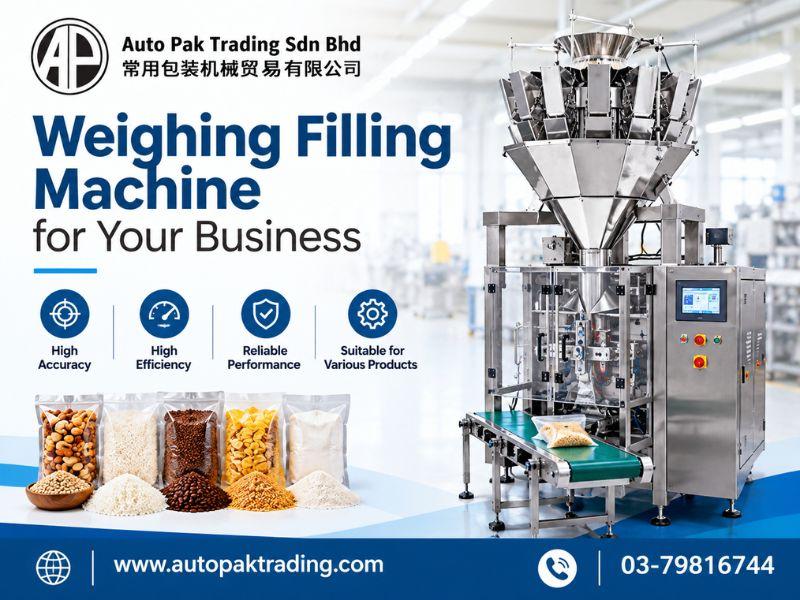
How to Choose the Right Weighing Filling Machine for Your Business
Choosing the right weighing filling machine depends on four key factors: the type of product being filled, the target fill weight, required production speed, and overall output volume. Matching these variables to the correct machine type — whether linear, multihead, or rotary — prevents costly downtime, reduces product giveaway, and ensures consistent packaging accuracy across every shift.
Why the Right Filling Machine Decision Matters More Than You Think
A wrong machine choice doesn't just slow down your line. It chips away at margins through inaccurate fills, frequent stoppages, and labour costs spent compensating for equipment that was never suited to your product in the first place.
For SMEs and mid-scale manufacturers, the stakes are especially high. Capital budgets are tighter, and there is less room to absorb losses from poor equipment fit. Purchasing managers need a structured framework — not just a brochure comparison — before committing to automatic filling equipment.
Step 1: Define Your Product Type First
This is the single most important starting point. The physical characteristics of your product determine which machine category is even worth considering.
Free-Flowing Granules and Powders
Products like sugar, rice, seeds, salt, and coffee granules flow consistently and respond well to multihead combination weighers. These machines use multiple weighing heads simultaneously, selecting combinations that match the target weight with high precision — often within ±0.5g.
Sticky, Irregular, or Fragile Products
Fresh produce, frozen foods, confectionery, and irregularly shaped items require gentler handling. Radial multihead weighers or linear weighers with slower feed rates are often better choices here. Forcing fragile products through high-speed equipment designed for granules causes breakage and rejects.
Liquids and Semi-Liquids
Sauces, oils, and pastes require volumetric or net-weight liquid filling systems — a different machine category altogether. If your product transitions between viscosities depending on temperature, your equipment needs to account for that variance too.
Step 2: Establish Your Target Weight Range
Every industrial filling machine is engineered for a specific weight range. Running a machine outside its optimal range causes accuracy problems. A 10-head weigher rated for 500g to 2kg packs will not perform reliably at 100g fills.
Key questions to answer before shortlisting machines:
- What is your minimum and maximum fill weight?
- Do you need to switch between multiple SKUs on the same line?
- What accuracy tolerance is acceptable — and what does your industry or retailer specification require?
Most packaging operations targeting retail compliance need to meet average quantity (AQL) standards. Consistently overfilling to stay safe is a silent margin killer — a well-calibrated weighing filling machine eliminates that waste.
Step 3: Match the Machine to Your Required Speed
Speed is expressed in weighing cycles per minute (CPM) or packs per minute (PPM). These numbers must align with your downstream packaging line, not just your aspirations.
What Affects Usable Speed?
- Product density and flow: Denser or stickier products slow cycle times regardless of machine rating.
- Pack size: Smaller packs require more cycles per minute to hit the same throughput as larger packs.
- Number of weighing heads: More heads generally mean faster, more accurate output. A 14-head or 16-head multihead weigher can achieve significantly higher throughput than a 10-head model on the same product.
A common mistake is specifying a machine by its peak-rated speed without accounting for real-world efficiency. For production planning purposes, assume 75–85% of rated speed as your operational benchmark.
Step 4: Assess Your Production Volume and Shift Structure
A small bakery running one shift of 200kg daily has very different needs from a contract packer running three shifts totalling 8,000kg. The volume-to-shift calculation affects not just the machine grade, but also construction quality, motor ratings, and expected maintenance intervals.
Consider these factors when evaluating machines by volume:
- Duty cycle: Is the machine rated for light-duty, medium-duty, or 24/7 industrial operation?
- Material construction: Food-grade stainless steel is essential for hygienic environments. Powder-coated carbon steel may suffice for non-food industrial applications.
- Cleandown requirements: High-allergen or high-rotation product lines need machines with tool-free disassembly and IP-rated components for washdown.
Step 5: Evaluate Integration with Your Packaging Line
A weighing filling machine does not operate in isolation. It sits within a line that typically includes a feeding conveyor, form-fill-seal (VFFS or HFFS) machine, checkweigher, and labelling or coding system.
Before finalising your selection, confirm:
- Does the machine output height and discharge chute align with your bagging machine infeed?
- What control system does it use — and does it communicate with your existing PLC or line controller?
- Does the supplier offer installation support and operator training?
Compatibility gaps between equipment components are one of the most overlooked causes of line underperformance. This is why buying from a supplier who understands full-line integration — not just individual machines — is a significant practical advantage.
Comparison Table: Weigher Types by Use Case
|
Weigher Type |
Best For |
Typical Speed |
Accuracy
|
|---|---|---|---|
|
Multihead Combination Weigher |
Free-flowing granules, snacks, frozen food |
40–120 PPM |
±0.5g or better |
|
Linear Weigher |
Fragile items, irregular shapes |
10–40 PPM |
±1–2g |
|
Net Weight Filler |
High-value products, large fills |
5–20 PPM |
±0.1–0.5% |
|
Volumetric Cup Filler |
Consistent dry products at lower cost |
30–80 PPM |
±2–5% |
Additional Factors That Often Get Overlooked
Local After-Sales Support
A machine is only as reliable as the support behind it. Downtime during peak production is expensive. When evaluating suppliers of packaging machine solutions, ask specifically about spare parts availability, local service engineers, and response time commitments. This is especially critical for businesses operating in Pakistan where import lead times for foreign-made parts can stretch to weeks.
Software and Data Capabilities
Modern automatic filling equipment increasingly includes onboard data logging, recipe management, and remote diagnostics. For manufacturers scaling toward larger retail contracts or export markets, these features support traceability and compliance documentation — requirements that are growing across regulated sectors.
Total Cost of Ownership vs. Purchase Price
A lower-priced machine with higher reject rates, more frequent maintenance, and expensive consumables often costs more over three years than a better-specified unit purchased at a higher upfront price. Build a simple TCO model before deciding: factor in energy consumption, reject rates, maintenance labour, and parts cost per year.
Making the Final Decision
Use a shortlist criteria document before requesting quotes. It should include your product type and physical characteristics, fill weight range and tolerance, required throughput in PPM, shift structure, available floor space, and integration requirements with existing equipment.
Supplier demonstrations using your actual product — not a generic substitute — are worth insisting on. Real-world performance on your specific material is the only test that counts.
For businesses in Pakistan looking for proven filling and packaging solutions, Autopak Trading offers a range of industrial filling machines suited to food, pharmaceutical, and industrial applications, backed by local technical support and application expertise.
Frequently Asked Questions
What is a weighing filling machine used for?
A weighing filling machine measures and dispenses a precise amount of product — by weight — into a container or bag. It is widely used in food processing, pharmaceuticals, and industrial manufacturing to ensure consistent fill weights, reduce product giveaway, and meet packaging compliance requirements.
How do I choose the right filling machine for my production line?
Start with your product type, then define your target fill weight range, required speed in packs per minute, and daily production volume. These four factors narrow down whether a multihead weigher, linear weigher, or net weight filler is the right fit for your specific operation.
What is the difference between a volumetric filler and a gravimetric weighing filler?
A volumetric filler measures product by volume using cups or augers, making it less accurate but faster and cheaper. A gravimetric or weighing filler measures by actual weight, delivering higher accuracy — typically ±0.5g or better — which is essential for high-value products or retail compliance requirements.
How many heads does a multihead weigher need for my application?
More heads improve both speed and accuracy by creating more weight combinations to choose from. A 10-head weigher suits lighter-duty applications; 14 to 16 heads are better for high-speed lines or products that are difficult to weigh consistently. Your product weight and required PPM will guide the right specification.
What maintenance does an industrial filling machine require?
Routine maintenance includes cleaning of hoppers and weigh pans, calibration checks, inspection of load cells, and lubrication of mechanical components. Frequency depends on product type and shift hours. Machines used in food environments typically require daily cleaning and periodic deep cleandowns to maintain hygiene standards.
Can one filling machine handle multiple product types?
Yes, many modern automatic filling machines support multiple recipes stored digitally, allowing quick changeovers between different products or pack sizes. However, physical product characteristics — such as density, stickiness, or particle size — still need to fall within the machine's rated operating range for accurate results


