








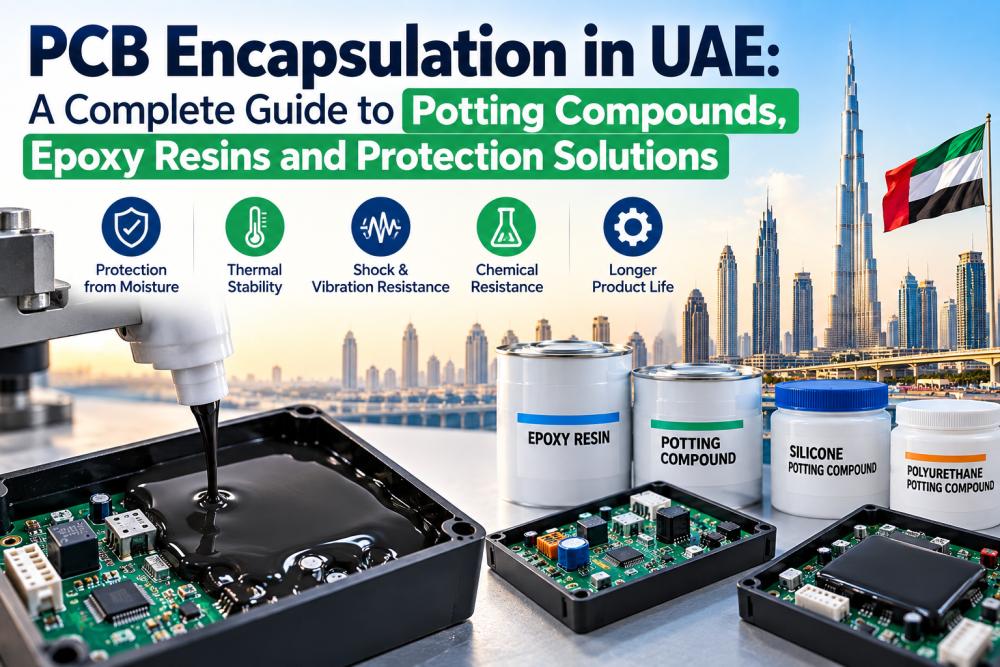
PCB Encapsulation in UAE: A Complete Guide to Potting Compounds, Epoxy Resins and Protection Solutions

Electronics operating in the Gulf face conditions that most circuit boards were never designed for. Summer temperatures regularly exceed 45°C. Humidity levels along the coast can sit above 80% for months. Airborne sand and dust work their way into every enclosure. Add salt exposure in coastal and marine installations, plus the temperature cycling between air-conditioned interiors and outdoor heat, and unprotected PCBs fail far sooner than their design life suggests.
PCB encapsulation is the standard answer to this problem. By potting or coating a circuit board in a protective resin, you isolate it from moisture, dust, vibration, and thermal stress. This guide explains how encapsulation works, which materials suit which applications, and how to source the right products in the UAE.
What Is PCB Encapsulation?
PCB encapsulation is the process of covering a printed circuit board and its components with a protective resin or compound. The material cures into a solid or semi-solid mass that seals the board against the surrounding environment.
Two terms are often used interchangeably, though they describe different approaches:
Potting involves filling an entire enclosure or housing with resin so the board is completely embedded. This is the heavier-duty option and is common in power supplies, sensors, LED drivers, and industrial control units.
Conformal coating applies a thin protective layer over the board surface, leaving components visible and the board relatively light. It is common in consumer electronics and densely packed assemblies.
Both approaches protect against moisture, contamination, and mechanical stress. Potting provides superior protection; conformal coating preserves serviceability and keeps weight down.
Why Encapsulation Matters in the UAE Climate
The Gulf environment creates a specific set of failure modes that encapsulation directly addresses.
Humidity and condensation. Moisture is the leading cause of electronics failure in coastal regions. It causes corrosion on tracks and solder joints, creates leakage currents between closely spaced conductors, and can trigger short circuits. Encapsulation blocks moisture from reaching the board entirely.
Thermal cycling. Electronics in the UAE move between cooled indoor environments and extreme outdoor heat. This expansion and contraction stresses solder joints and component leads. A potting compound with a suitable coefficient of thermal expansion absorbs some of that stress and reduces fatigue.
Sand and dust ingress. Fine desert dust penetrates enclosures that are not fully sealed and settles on circuit boards. Conductive dust, particularly in industrial settings, can cause shorts. Encapsulation eliminates the air gaps where dust accumulates.
Vibration and mechanical shock. Equipment mounted on machinery, vehicles, or outdoor structures experiences continuous vibration. Potting compounds hold components in place and dampen vibration transmission.
Salt air in coastal installations. Marine and coastal sites expose electronics to salt-laden air, which accelerates corrosion dramatically. Encapsulation is essential in these environments.
Types of Potting Compounds and Encapsulation Resins
Different applications call for different materials. The main categories are:
Epoxy Resins
Epoxy is the workhorse of electronics encapsulation. It offers excellent mechanical strength, strong adhesion to most substrates, good chemical resistance, and reliable electrical insulation. Epoxy systems are rigid once cured, which makes them ideal for boards that need structural protection.
The trade-off is rigidity itself. A very rigid compound can transmit thermal expansion stress to components if the formulation is not matched to the application. For this reason, formulators often modify epoxy systems to reduce stress while retaining mechanical strength.
Epoxy is widely used for power electronics, transformers, sensors, and industrial control boards.
Polyurethane Compounds
Polyurethane is more flexible than epoxy and handles thermal cycling better in some applications. It adheres well to plastics and offers good resistance to impact and abrasion. It is often chosen for applications where some flexibility is beneficial and where the board may experience repeated temperature swings.
Polyurethane tends to have lower thermal conductivity than epoxy and is less resistant to certain chemicals.
Silicone Compounds
Silicone remains flexible across a very wide temperature range, which makes it ideal for extreme environments. It handles high temperatures well, resists UV degradation, and places minimal stress on components because of its elasticity. It is often used for LED modules, automotive electronics, and applications requiring thermal stability.
Silicone generally has lower mechanical strength than epoxy and higher cost.
UV-Curable and Two-Part Systems
For production environments, UV-curable compounds offer very fast cure times, which speeds up assembly lines. Two-part systems, mixed at the point of application, provide controlled curing and are the standard for most potting operations.
Choosing the Right Material for Your Application
Selecting a potting compound is a balancing act. Key factors include:
-
Operating temperature range — critical for UAE outdoor installations
-
Thermal conductivity — important where heat must be dissipated through the compound
-
Coefficient of thermal expansion — must be compatible with components and substrate
-
Cure time and method — determines production throughput
-
Hardness and flexibility — rigid for structural protection, flexible for thermal cycling
-
Adhesion — must bond reliably to the housing and board materials
-
Chemical resistance — relevant for industrial, automotive, and marine uses
-
Electrical properties — dielectric strength and volume resistivity
-
Flame retardancy — required in many safety-critical and building applications
For UAE installations, thermal performance and moisture resistance usually top the list, with UV stability and salt resistance added for outdoor and coastal sites.
Applications Across Industries
Encapsulation and potting are used across a wide range of sectors in the region:
LED lighting. LED drivers and modules require potting to manage heat, protect against moisture, and maintain light output over time. Optical clarity matters here, so formulators balance protection with light transmission.
Power supplies and transformers. These generate significant heat and require compounds with good thermal conductivity to move heat away from windings and components.
Industrial control and automation. Controllers, sensors, and motor drives in factories and process plants need protection from dust, vibration, and temperature extremes.
Automotive and transport. Sensors, control modules, and battery systems require materials that handle vibration, thermal cycling, and in some cases chemical exposure.
Renewable energy. Solar inverters and related electronics operate outdoors in harsh conditions and depend heavily on encapsulation for longevity.
Marine and offshore. Salt resistance is the priority here, along with resistance to constant humidity.
Telecommunications. Outdoor enclosures, antenna electronics, and street-level equipment all benefit from sealing against dust and moisture.
Epoxy Adhesives: The Related Requirement
Encapsulation is often only part of the picture. Many assemblies also require structural bonding — attaching heat sinks, bonding components to housings, or assembling enclosures. This is where epoxy adhesives come in.
Epoxy adhesives share many properties with potting compounds: strong bonding, chemical resistance, electrical insulation, and durability. They differ in formulation, typically being optimised for bond strength and gap filling rather than bulk encapsulation.
In practice, a single production line often uses both potting compounds and structural adhesives, and sourcing them from one supplier simplifies specification and compatibility testing.
Working with a Formulated Systems Supplier
The chemistry of potting compounds is rarely off-the-shelf. Different applications demand different viscosities, cure profiles, hardness levels, thermal conductivities, and flame ratings. This is why formulators exist — they develop and supply systems tuned to specific requirements.
When sourcing for UAE operations, look for a supplier that:
-
Offers a range of chemistries rather than a single product line
-
Can adjust formulations for local climate conditions
-
Provides technical support on mixing, dispensing, and curing
-
Understands the regulatory and standards requirements of your industry
-
Can supply consistently across the region, with reliable lead times
For electronics encapsulation specifically, this PCB encapsulation UAE page covers the formulated systems available for electronic applications, including potting and protection solutions.
Dispensing and Processing Considerations
The best material performs poorly if it is processed incorrectly. A few practical points matter in production:
Mixing accuracy. Two-part systems must be mixed at the correct ratio. Incorrect ratios lead to incomplete cure, soft spots, or poor adhesion.
Degassing. Air trapped during mixing creates voids that reduce protection and can cause arcing in high-voltage applications. Vacuum degassing is common for critical work.
Potting depth. Thick sections cure differently from thin ones. Exothermic reactions in large volumes can generate enough heat to damage components if the formulation is not designed for it.
Curing conditions. Some systems cure at room temperature, others require elevated temperature. Cure schedule affects both speed and final properties.
Dispensing equipment. Consistent, repeatable dispensing matters in production. Manual mixing works for low volumes; meter-mix equipment is standard for larger operations.
If you are setting up a new production line in the UAE, discussing processing requirements with your materials supplier before finalising the specification saves considerable rework later.
Sourcing Chemicals Across the Region
Companies operating across the Middle East and Africa often need consistent supply across multiple countries, with uniform specifications and coordinated technical support. Distribution networks matter as much as product range in these situations, since lead times and local availability directly affect production schedules.
For a broader view of what is available across the region, this industrial chemicals MEA page outlines supply capabilities and product categories for the Middle East and Africa.
Common Mistakes to Avoid
Choosing based only on price. A cheaper compound that fails in service costs far more than the saving on material.
Ignoring thermal expansion mismatch. Rigid compounds applied without thought to substrate and component expansion can cause failure during thermal cycling.
Skipping compatibility testing. Different materials interact. Adhesives, potting compounds, housing plastics, and board coatings must be tested together.
Underestimating cure requirements. Humidity and temperature in UAE facilities can affect cure profiles, particularly for moisture-curing systems.
Overlooking regulatory requirements. Flame retardancy, RoHS compliance, and industry-specific standards may apply to your product.
Frequently Asked Questions
What is the difference between potting and conformal coating? Potting embeds the entire board in resin, offering maximum protection. Conformal coating applies a thin layer, preserving serviceability and reducing weight.
Which resin is best for UAE conditions? It depends on the application. Epoxy offers strong protection and mechanical strength; polyurethane and silicone handle thermal cycling and flexibility better. Many outdoor UAE applications use epoxy or silicone systems.
Can encapsulated boards be repaired? Generally not easily. Potting is a permanent solution. If serviceability matters, conformal coating is the better choice.
Do potting compounds provide heat dissipation? Some do. Thermally conductive formulations are available for applications where heat must move from components to the housing or environment.
Is encapsulation necessary for indoor electronics in the UAE? Not always, but dust and humidity still affect indoor equipment, and air conditioning creates condensation cycles. Protection extends service life in most cases.
How do I choose between epoxy and polyurethane? Consider rigidity needs, thermal cycling, chemical exposure, and adhesion requirements. Epoxy for strength and chemical resistance; polyurethane for flexibility and impact resistance.
Final Thoughts
PCB encapsulation is not a luxury in the Gulf — it is a practical requirement for electronics expected to survive the climate. Choosing the right chemistry, matching it to your thermal and mechanical requirements, and processing it correctly determines whether your product lasts months or years.
If you are working on a new assembly or looking to improve the reliability of existing products, review the LED potting resin supplier UAE options and formulated systems available for electronics, and discuss your specific requirements with a supplier who understands both the chemistry and the local operating conditions. Getting the material right at the specification stage is far easier than fixing field failures later.


