








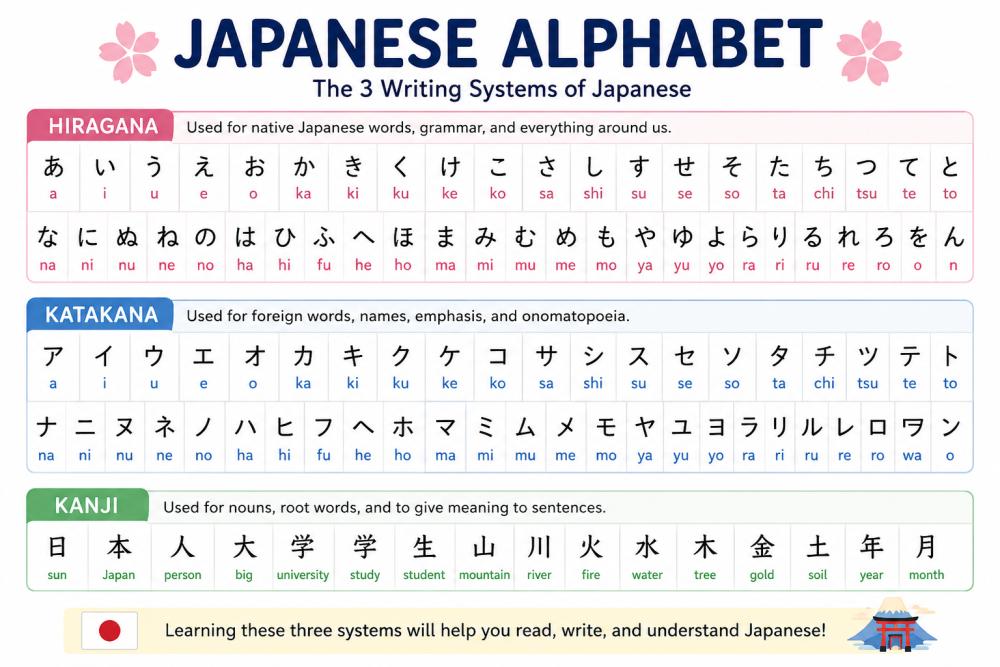
Japanese Alphabet Writing Explained: Hiragana, Kazumi School & Kanji

Japanese has no single alphabet. It combines three scripts: hiragana (46 basic characters for native words and grammar), katakana (46 characters for foreign words and emphasis), and kanji (Chinese-derived characters that carry meaning). Romaji, which spells Japanese in A-to-Z letters, is mainly a learning aid.
Why People Search for the Japanese Alphabet
Most English speakers expect a fixed set of letters like A to Z. Japanese works differently. Many beginners search For trending Japanese Alphabet or Japanese letters A to Z because they want a quick map from familiar letters to unfamiliar characters.
The good news is that the system is more logical than it first looks. Once you know what each script does, a Japanese sentence stops looking like a wall of symbols.
The Three Japanese Scripts at a Glance
| Script | Type | Basic count | Main use | Example |
|---|---|---|---|---|
| Hiragana | Syllabary | 46 | Native words, grammar, endings | さくら (sakura) |
| Katakana | Syllabary | 46 | Foreign loanwords, names, emphasis | コーヒー (kōhī, coffee) |
| Kanji | Logographic | Thousands | Core meaning of words | 日本 (Nihon, Japan) |
A syllabary means each character represents a sound (usually a consonant plus vowel), not a single letter. A kanji represents an idea or word.
Hiragana: The Foundation
Hiragana is the first script most learners study, and it's also what Japanese children learn first. It's rounded and flowing, and it fills three main roles:
- Native Japanese words that have no kanji or are usually written without it, such as ありがとう (arigatō, thank you)
- Grammar particles, such as は (wa), を (o), and に (ni)
- Verb and adjective endings, such as the -ru in 食べる (taberu, to eat)
- Furigana, tiny hiragana printed above kanji to show how to read them
Hiragana Building Blocks
The 46 base characters follow a grid of five vowels (a, i, u, e, o) combined with consonants (k, s, t, n, h, m, y, r, w), plus the standalone ん (n). You can then expand the set with:
- Dakuten (゛): changes k to g, s to z, t to d, and h to b (か → が)
- Handakuten (゜): changes h to p (は → ぱ)
- Small ゃ, ゅ, ょ: create blended sounds like きゃ (kya)
- Small っ: signals a doubled consonant, as in きって (kitte, stamp)
Katakana: Hiragana's Angular Sibling
Katakana represents the same sounds as hiragana but uses sharper, simpler shapes. Think of it as the script for anything that should stand out or comes from outside Japanese.
Common uses include:
- Loanwords: テレビ (terebi, TV), ホテル (hoteru, hotel)
- Foreign names: アリス (Arisu, Alice)
- Product names, signs, and ads: for visual punch
- Onomatopoeia and emphasis: similar to italics in English
- Scientific and animal names: often written in katakana
Katakana also adds a long-vowel mark (ー), used in words like ラーメン (rāmen).
Learner tip: Katakana looks similar across a few pairs, like シ (shi) and ツ (tsu), or ソ (so) and ン (n). Direction of the strokes matters, so practice writing them, not just recognizing them.
Kanji: Characters That Carry Meaning
Kanji came to Japan from China and were adapted over many centuries. Each character usually represents a meaning, and most have more than one reading.
Examples:
- 水 (water)
- 山 (mountain)
- 学 (study)
- 日本語 (Nihongo, the Japanese language)
Why Kanji Exist at All
Japanese has no spaces between words. Kanji help your eyes find word boundaries quickly. They also separate homophones: kami can mean 紙 (paper), 神 (god), or 髪 (hair).
On'yomi and Kun'yomi
Most kanji have two kinds of readings:
- On'yomi: based on the original Chinese pronunciation, common in compound words
- Kun'yomi: the native Japanese reading, common when a kanji stands alone
For example, 山 is read yama on its own (kun'yomi) but san in 富士山 (Fujisan, Mt. Fuji).
How Many Kanji Do You Need?
Japan's government maintains a list of jōyō kanji, the 2,136 characters designated for general daily use, including newspapers and official documents. You don't need all of them to start. A few hundred give you a strong base for everyday reading.
Romaji: Japanese in A to Z Letters
Romaji writes Japanese with the Latin alphabet. The most common system is Hepburn romanization, which follows English-friendly spelling (Advanced Japanese Letters A to Z).
You'll see romaji in:
- Textbooks and apps for beginners
- Train station signs and maps
- Typing Japanese on a keyboard (you type romaji, and your device converts it to kana and kanji)
Romaji is useful early on, but relying on it too long slows reading progress. It hides distinctions like long vowels and doesn't prepare you for real Japanese text.
How the Scripts Work Together in One Sentence
Take this sentence: 私はコーヒーを飲みます。 (Watashi wa kōhī o nomimasu, I drink coffee.)
- 私 (kanji): I
- は (hiragana): topic particle
- コーヒー (katakana): coffee, a loanword
- を (hiragana): object particle
- 飲 (kanji) + みます (hiragana): the verb drink with its polite ending
All three scripts appear in a single short sentence, and each has a clear job.
A Practical Learning Order
- Learn hiragana first. It unlocks grammar and pronunciation. Many learners get through it in a couple of weeks of steady practice, though pace varies by person.
- Learn katakana next. You'll already know the sound system, and loanwords you recognize make it rewarding.
- Start kanji alongside vocabulary. Learn kanji inside real words (like 学校, gakkō, school) instead of memorizing isolated characters.
- Use romaji sparingly. Treat it as training wheels.
- Read simple material. Graded readers and children's books reinforce all three scripts.
Common Beginner Mistakes
- Skipping handwriting and relying only on recognition
- Mixing up look-alike katakana
- Memorizing kanji readings in isolation
- Staying on romaji too long
FAQ's
1. Does Japanese have an alphabet?
No. Japanese uses hiragana, katakana, and kanji. Hiragana and katakana are syllabaries, and kanji are logographic characters.
2. How many Japanese scripts are there?
Three main scripts, plus romaji (Latin letters) used in specific situations.
3. What is the difference between hiragana and katakana?
Both represent the same sounds. Hiragana is used for native words and grammar. Katakana is used mostly for foreign loanwords, names, and emphasis.
4. Should I learn hiragana or katakana first?
Hiragana first. It's essential for grammar and appears in nearly every Japanese sentence.
5. How many kanji do I need to read Japanese?
The government's jōyō list has 2,136 characters for general use. Beginners can start with a few hundred common ones.
6. Is there a Japanese A to Z?
Not natively. Romaji lets you write Japanese using A to Z letters, but it's not how Japanese is normally written.
7. Why does Japanese use three scripts?
They evolved historically and now serve different purposes: meaning (kanji), grammar (hiragana), and foreign or emphasized words (katakana).
8. Can I learn Japanese using only romaji?
You can start that way, but you'll hit a ceiling. Real texts, signs, and apps use kana and kanji.
9. What is furigana?
Small hiragana written next to kanji to show their pronunciation. It's common in children's books and learner materials.
10. How do Japanese people type?
Usually by typing romaji or kana on a keyboard, then selecting the correct kanji from a list of suggestions.
Conclusion
Japanese writing looks complicated until you see that each script has a defined role. Hiragana handles grammar, katakana handles foreign and emphasized words, kanji carry meaning, and romaji helps you get started. Learn them in that order, practice with real words, and the system becomes intuitive faster than most beginners expect.


