








Russian Language Course: A Complete Guide for Beginners

Russian is one of the most widely spoken languages in the world. More than 250 million people speak it, and it is an official language in Russia, Belarus, Kazakhstan, and Kyrgyzstan. It is also used in many other countries across Eastern Europe and Central Asia.
People decide to take a Learn Russian language course for many reasons. Some want to travel. Some want a better job in trade, science, or diplomacy. Others love Russian books, films, or music. And some just want a fun challenge.
Here is the good news: Russian looks harder than it is. Many beginners feel scared at first, but with a clear plan and the right course, you can make steady progress. This guide will show you how.
Is Russian Really Hard to Learn?
Let's be honest. Russian is harder than Spanish or French for English speakers. The US Foreign Service Institute puts it in a group of languages that take about 1,100 hours of study to reach strong working skills.
But "harder" does not mean "impossible." Here is what makes Russian tricky, and what makes it easier than you think.
What is tricky:
- A new alphabet (Cyrillic)
- Six grammar cases
- Verbs of motion and verb aspects
- Some sounds that English does not have
What is easier than you think:
- Russian spelling is fairly regular. Once you learn the rules, you can read most words out loud.
- There are no articles. You never need to decide between "a" and "the."
- The present tense is simple. You do not need many tenses to speak.
- Word order is flexible, so small mistakes rarely stop people from understanding you.
Most beginners feel the biggest jump in the first few weeks. After that, things start to click.
Step 1: Learn the Russian Alphabet First
Every good Russian language course starts with the alphabet. It has 33 letters, and it sounds like a lot. But you already know many of them.
Some letters look and sound like English ones, such as А, К, М, О, and Т. Some look familiar but sound different, such as В (sounds like "v"), Н (sounds like "n"), Р (sounds like a rolled "r"), and С (sounds like "s"). A few are completely new, like Ж, Ш, Щ, and Ы.
Most learners can read the whole alphabet in a week or two if they practice a little each day. Try these simple tips:
- Learn five or six letters per day.
- Say each letter out loud as you write it.
- Read street signs, menus, and product labels online.
- Practice with easy words like мама (mom), банк (bank), and метро (metro).
Don't skip this step. Reading Cyrillic well will make every other part of your learning easier.
Step 2: Get the Pronunciation Right Early
Many people put off pronunciation, then find bad habits hard to fix. It is better to work on sounds from day one.
Pay attention to these points:
- Stress matters. Every Russian word has one stressed syllable, and the other vowels get weaker. For example, молоко (milk) sounds like "muh-lah-KOH."
- Hard and soft consonants. Russian has pairs like мат and мать. The soft version is made by pressing the middle of your tongue toward the roof of your mouth.
- The rolled R. It takes practice. Don't worry if you cannot do it right away.
Listen to native speakers as much as you can. Repeat after them, record yourself, and compare. A good course will include audio for every lesson.
Step 3: Learn Basic Words and Phrases
Once you can read, start building a small set of useful words. Focus on what you will really use.
Greetings and politeness:
- Привет (hi)
- Здравствуйте (hello, formal)
- Пожалуйста (please / you're welcome)
- Спасибо (thank you)
- До свидания (goodbye)
Simple questions:
- Как тебя зовут? (What is your name?)
- Откуда ты? (Where are you from?)
- Сколько это стоит? (How much is this?)
Aim for the first 500 to 1,000 most common words. Studies on language learning show that a small group of common words covers a large part of everyday speech. Use flashcard apps and review them every day. Ten minutes a day works better than one long session per week.
Step 4: Understand the Basics of Russian Grammar
Grammar is where many learners feel stuck, but you do not need to learn everything at once. A good beginner course teaches grammar in small, clear steps.
Noun Cases
Russian nouns change their endings depending on their role in the sentence. There are six cases:
- Nominative (the subject)
- Genitive (possession, "of")
- Dative (the receiver, "to")
- Accusative (the direct object)
- Instrumental (the tool, "with")
- Prepositional (location, "about")
Do not try to memorize all the tables in week one. Start with the nominative and accusative, then add the others slowly as you meet them in real sentences.
Gender
Russian nouns are masculine, feminine, or neuter. You can usually guess the gender from the ending. Words ending in a consonant are usually masculine, words ending in -а or -я are usually feminine, and words ending in -о or -е are usually neuter.
Verbs
Russian verbs have three tenses: past, present, and future. That is simpler than English! The tricky part is aspect. Most verbs come in pairs, one for ongoing or repeated actions and one for finished actions. For example, читать (to read, in progress) and прочитать (to read, and finish). Learn these in pairs from the start.
Types of Russian Language Courses
There are many ways to learn. The best Russian language course is the one you will actually stick with. Here are the main options.
Online Self-Study Courses
These are flexible and often cheap. You learn at your own pace with video lessons, quizzes, and audio. They work well if you are disciplined. The downside is that you get little speaking practice and no one to correct your mistakes.
Online Courses with a Live Teacher
Video lessons with a tutor give you feedback, speaking practice, and a clear plan. They cost more, but many learners progress faster this way. Look for teachers who are native speakers and have experience with beginners.
Classroom Courses
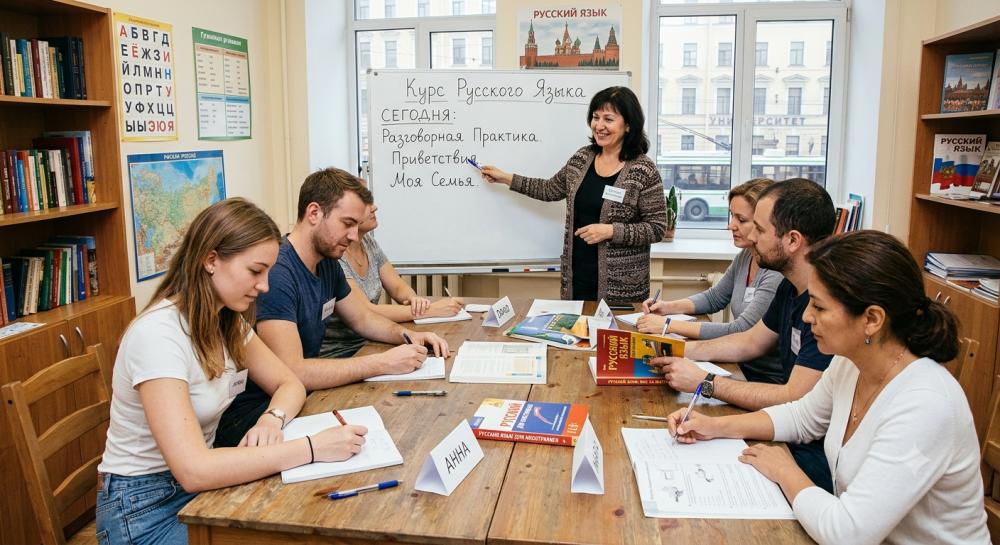
Universities and language schools offer in-person classes. You get structure, classmates, and a set schedule. This is a good choice if you enjoy learning in a group and live near a school.
Language Apps
Apps are great for daily practice, vocabulary, and reading. But they rarely explain grammar well. Use them as a helper, not as your only tool.
Textbooks
Books such as Russian for Everybody or New Russian Textbook give deep grammar explanations. They pair well with an online course.
How to Choose the Right Russian Course
Before you pay for anything, ask yourself a few questions.
What is my goal? Travel, work, exams, or fun? A traveler needs speaking and listening. A student may need reading and writing too.
How much time do I have? Be realistic. Thirty minutes a day is better than a plan you cannot keep.
Does the course cover all four skills? A complete Russian language course should teach reading, writing, listening, and speaking.
Does it offer a free trial? Try a lesson before you commit.
Are there real reviews? Read what other learners say, especially about teaching quality and support.
Does it prepare for exams? If you need a certificate, look for courses that prepare you for TORFL, the official Russian proficiency test.
A Simple 12-Week Study Plan for Beginners
Here is an example you can follow or adjust.
Weeks 1–2: Learn the alphabet and basic sounds. Practice reading simple words.
Weeks 3–4: Learn greetings, numbers, and how to introduce yourself. Start using flashcards every day.
Weeks 5–6: Learn the present tense and basic sentence patterns. Learn about gender and the nominative case.
Weeks 7–8: Add the accusative and prepositional cases. Learn words for food, family, and places.
Weeks 9–10: Learn the past tense. Practice short conversations with a tutor or language partner.
Weeks 11–12: Review everything. Try to read a short text and write a few sentences about your day.
After twelve weeks, you will not be fluent, but you will be able to have simple conversations. That is a great start.
Practical Tips to Learn Faster
- Study a little every day. Consistency beats long, rare sessions.
- Speak from the start. Do not wait until you feel ready. Even simple sentences count.
- Listen a lot. Try Russian podcasts for learners, songs, and YouTube channels made for beginners.
- Use spaced repetition. Apps like Anki help you review words just before you forget them.
- Label things at home. Put Russian words on your fridge, door, and desk.
- Keep a small notebook. Write down new words and mistakes, then review them weekly.
- Find a language partner. Exchange apps let you chat with native Russian speakers who want to learn English.
- Don't fear mistakes. Every learner makes them. They are proof that you are trying.
Common Mistakes Beginners Make
- Skipping the alphabet and relying on English spelling for Russian words.
- Memorizing case tables without practicing them in real sentences.
- Ignoring stress, which makes speech hard to understand.
- Trying to learn too much at once, which leads to burnout.
- Studying alone with no speaking practice.
- Giving up too early. The first two months feel slow, but progress builds fast after that.
Useful Resources for Beginners
- Textbooks: Russian for Everybody, Golosa, New Russian Textbook
- Apps: Duolingo, Memrise, Anki, Drops
- Video: Russian with Max and Real Russian Club on YouTube
- Dictionaries: Reverso Context and Wiktionary are helpful for seeing words in real sentences
- Practice: Tandem and HelloTalk for language exchange, or tutor platforms like italki
Final Thoughts
Learning Russian is a big goal, but it is a very rewarding one. It opens the door to a rich culture, great literature, and millions of new people to talk to. The key is to start with the basics, keep a steady routine, and choose a Russian language course that matches your goals and your style.
Start small. Learn the alphabet this week. Say your first words out loud. Then keep going, one lesson at a time. In a few months, you will look back and be surprised at how far you have come.
Ready to begin? Pick a course, set your first goal, and take your first step today. Удачи! (Good luck!)


