








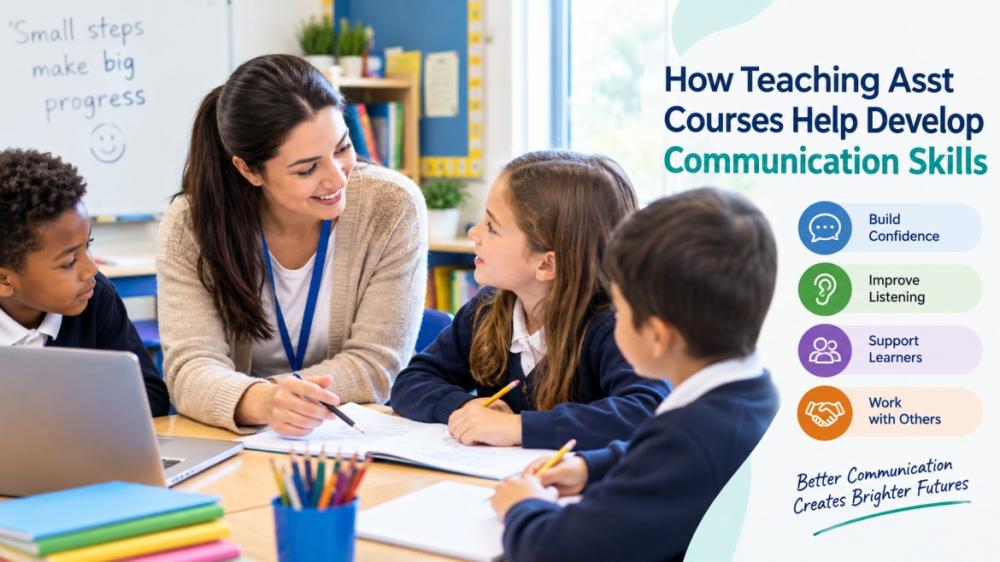
How Teaching Asst Courses Help Develop Communication Skills

Strong communication is one of the most useful abilities in any educational environment. For people preparing to support teachers and learners, classroom assistant training can provide opportunities to practise explaining ideas, listening carefully, giving feedback, and communicating professionally. These skills matter because teaching assistants regularly interact with pupils, teachers, parents, and other members of the education team.
Why Communication Matters in Classroom Support
A teaching assistant may spend much of the day helping learners understand instructions, complete activities, participate in discussions, or overcome difficulties. These responsibilities require more than subject knowledge. The ability to communicate clearly can influence how comfortably students ask questions and how effectively they understand the support being provided.
Training can introduce learners to different communication approaches and help them understand that one style does not work for every student. Some pupils may respond well to direct explanations, while others may benefit from examples, demonstrations, questions, or additional encouragement.
This is one reason teaching asst courses can be useful for people who want to develop practical communication habits before entering a classroom setting.
Developing Active Listening Skills
Communication is not simply about speaking. Listening is equally important, particularly when supporting children who may find it difficult to explain what they need.
Teaching assistant training courses can encourage learners to pay attention to verbal and non-verbal signals. A student may say that they understand an activity while their expressions or actions suggest otherwise. Learning to notice these differences can help an assistant decide when to repeat an explanation or try another approach.
Active listening can also involve giving students enough time to respond. Instead of immediately providing an answer, an assistant can ask an additional question or encourage the learner to explain their thinking. This creates a more supportive conversation and can help students become more confident when expressing themselves.
Learning to Explain Ideas Clearly
Classroom instructions can sometimes seem straightforward to an adult but confusing to a child. Teaching assistants therefore need to adapt explanations according to age, ability, and the situation.
Teaching support courses may cover methods for presenting information in manageable steps. Rather than giving a long explanation, an assistant might divide an activity into smaller instructions and check understanding along the way.
For example, if a student is struggling with a written task, simply repeating the same instruction may not solve the problem. A clearer approach could involve explaining the first step, providing a simple example, and then asking the learner to describe what they need to do next.
This type of communication can make classroom support more practical and student-focused.
Building Confidence Through Classroom Interaction
For someone new to education, speaking in front of students can initially feel unfamiliar. Regular practice can make these interactions more natural.
Courses for teaching assistants can provide opportunities to explore classroom scenarios and consider how different responses might affect students. Preparing questions, explaining activities, and discussing possible classroom situations can gradually improve confidence.
Confidence does not necessarily mean speaking more. In many classroom situations, effective communication involves knowing when to speak, when to listen, and when to give a learner time to think.
Training can also help prospective assistants understand the importance of maintaining a calm and professional tone, especially when dealing with challenging situations.
Improving Feedback and Encouragement
Feedback is another important part of classroom communication. Students need to know what they are doing well and where they can improve, but feedback needs to be presented carefully.
A useful comment should be specific rather than simply saying that an answer is “good” or “wrong.” For instance, an assistant might point out a particular part of an assignment that was completed successfully and then explain one area that could be developed.
Teaching assistant professional courses can help learners understand how constructive feedback can encourage progress without discouraging students.
The same principle applies to verbal encouragement. Instead of offering general praise, an assistant can recognise effort, persistence, organisation, or improvement. This gives students clearer information about the behaviours that support learning.
Communicating With Teachers and Education Staff
Communication skills are also important outside direct student interaction. Teaching assistants normally work as part of a wider educational team, which means they need to communicate appropriately with teachers and other staff.
Training can introduce learners to professional communication practices, including asking relevant questions, sharing observations, following instructions, and raising concerns through appropriate channels.
University-based teaching assistant training programmes similarly highlight communication with students and course supervisors as an important part of TA development. The University of Toronto, for example, includes communicating with students and working with course supervisors among its TA training areas.
This can be particularly useful when an assistant notices that a learner is having difficulty. Instead of attempting to solve every issue independently, the assistant needs to understand when and how to communicate the concern to the appropriate teacher or staff member.
Understanding Different Communication Needs
Every classroom contains learners with different personalities, backgrounds, abilities, and learning preferences. Effective communication therefore requires flexibility.
Teacher assistant training can help learners consider how language, tone, examples, visual materials, and questioning techniques may influence understanding.
Teaching assistant competency frameworks also identify active listening, clear presentations, effective questioning, student mentoring, and communication as important development areas.
For example, a student who is reluctant to speak in front of a group may be more comfortable answering a question individually. Another learner may understand an explanation more easily when visual examples are included.
Recognising these differences can help an assistant communicate with greater patience and awareness.
Developing Professional Communication Habits
Communication extends beyond classroom conversations. Teaching assistants may need to write messages, respond to questions, record observations, or communicate with colleagues through digital platforms.
Teaching asst courses can help learners become more conscious of professional language and appropriate communication boundaries. Guidance from the University of Toronto's TA training resources, for example, recommends that communication with students remains concise, polite, and professional, particularly when using email.
Developing these habits early can make it easier for new assistants to adjust to professional expectations.
Choosing Training That Supports Communication Development
When comparing teaching asst courses, prospective learners may want to look beyond basic course content. It can be useful to consider whether the training covers classroom communication, student support, feedback, behaviour management, teamwork, and professional responsibilities.
A course that combines theoretical knowledge with practical examples can give learners more opportunities to think about how communication works in realistic classroom situations.
For those exploring online study options, UK Open College provides education-focused courses that can be considered alongside other training choices. Learners should review course content, study requirements, and learning outcomes before deciding which option matches their goals.
For additional guidance on selecting an appropriate programme, readers can also explore this related resource: “How to Choose the Right Teacher Assistant Course Online for Your Goals.” It provides another perspective on factors learners may consider when comparing course options.
Final Thoughts
Communication is at the centre of effective classroom support. From listening to students and explaining instructions to providing feedback and communicating with teachers, teaching assistants rely on these skills throughout their working day.
Well-structured teaching asst courses can help learners understand the principles behind effective communication while giving them opportunities to consider how those principles apply in classroom situations. With practice, patience, and the right training, communication can become a valuable professional skill that supports both educators and learners.
FAQs
1. Why are communication skills important for teaching assistants?
They help teaching assistants explain instructions, listen to students, provide feedback, and communicate effectively with teachers and other staff.
2. Can communication skills be improved through training?
Yes. Training can introduce learners to active listening, questioning, feedback, professional communication, and different ways of explaining information.
3. What communication skills should a teaching assistant develop?
Important skills include active listening, clear speaking, professional writing, questioning, constructive feedback, patience, and adapting communication to different learners.
4. Are communication skills useful outside the classroom?
Yes. Teaching assistants may communicate with teachers, parents, support staff, and education professionals, making professional communication valuable in many situations.
5. What should learners consider when choosing a teaching assistant course?
They can compare course content, learning format, practical activities, assessment methods, flexibility, and whether communication and classroom-support skills are included.


