








How AI Voice Agents Improve Telecom Customer Service and Contact Center Efficiency

Telecom customers expect fast, reliable support at any time of day. However, traditional IVR systems and high call volumes can create long wait times, repetitive interactions, and rising contact-center costs.
An AI voice agent for telecom can help operators automate routine voice interactions while keeping human agents available for complex and sensitive conversations. By understanding customer intent, completing common tasks, and transferring difficult cases with full context, AI voice agents can improve both customer experience and contact-center efficiency.
Why Traditional IVR Is No Longer Enough
Traditional IVR systems typically depend on predefined menus. Customers must listen to options and select the correct number before reaching the required service.
This approach can become frustrating when customers have questions that do not fit neatly into a menu.
Telecom customers may call to:
- Check their balance
- Activate a service
- Check an outage
- Change a plan
- Reset a password
- Ask about billing
- Schedule an appointment
When routine requests enter live-agent queues, wait times and operating costs can increase. AI voice agents provide another option by allowing customers to explain their needs naturally instead of navigating rigid phone trees.
What Is an AI Voice Agent for Telecom?
An AI voice agent is an AI-powered voice system that uses natural language processing and speech technology to understand and respond to customer conversations.
Unlike traditional IVR, it can understand the customer's intent and respond conversationally.
For telecom operators, an AI voice agent can connect with systems such as billing, provisioning, and CRM platforms. This allows it to do more than answer questions. It can complete supported tasks within the customer's interaction.
When an issue requires human judgment, the conversation can be transferred to an agent with the relevant context. Customers therefore do not have to start the conversation again.
How AI Voice Agents Improve Telecom Customer Experience
1. Provide 24/7 Customer Support
Telecom customers do not always need assistance during standard business hours.
Network issues, billing questions, account requests, and service problems can occur at any time. An AI voice agent can provide always-on support for routine requests without requiring operators to maintain large live-agent teams around the clock.
This creates faster access to support while reducing dependence on staffing for predictable call volumes.
Sequential Tech's AI Voice Agent is designed to provide 24/7 availability for routine telecom enquiries.
2. Reduce Customer Wait Times
Long queues can quickly damage the customer experience.
When AI handles routine requests automatically, those interactions do not need to enter a live-agent queue. Customers can receive immediate responses for supported tasks.
This can help reduce waiting time and allow human agents to focus on customers who require more specialized assistance.
3. Automate High-Volume Telecom Requests
Many telecom calls are repetitive.
Customers frequently contact providers about balances, activations, outages, password resets, plan information, and similar requests.
AI voice automation can handle these interactions consistently and at scale. This allows operators to automate predictable workloads while maintaining human support for more complicated cases.
4. Improve Human Agent Productivity
AI voice agents are not necessarily designed to replace human customer-service teams.
Instead, they can act as a first layer of support.
When AI handles routine enquiries, human agents can spend more time on complex technical issues, sensitive customer situations, escalations, retention conversations, and other high-value interactions.
This can improve how contact-center resources are allocated.
5. Create Smoother Human Handoffs
One major problem with automated support is forcing customers to repeat information after reaching a human agent.
AI voice agents can reduce this problem by transferring the conversation along with its context.
The human agent can then understand what the customer has already discussed and continue from that point.
Sequential Tech specifically describes contextual escalation as a core capability of its AI Voice Agent.
Integrating AI With Telecom Systems
AI voice automation becomes more valuable when it can interact with the systems that support telecom operations.
For example, an AI voice agent can connect with billing and provisioning systems to support routine requests.
It can also integrate with CRM and contact-center platforms to maintain customer information and interaction context.
This creates a more connected customer journey instead of using AI as a standalone voicebot. Sequential Tech's solution is designed to integrate with billing, provisioning, CRM, OSS/BSS, and existing contact-center environments.
Supporting Inbound and Outbound Interactions
AI voice agents can support more than incoming customer calls.
They can also assist with outbound activities such as reminders, follow-ups, renewals, surveys, and other customer communications.
This gives telecom operators another way to automate high-volume voice workflows while maintaining consistent messaging.
For example, routine renewal reminders can be automated while customers who need additional assistance can be transferred to human representatives.
Improving Multilingual Telecom Support
Global telecom operators often serve customers across different languages and regions.
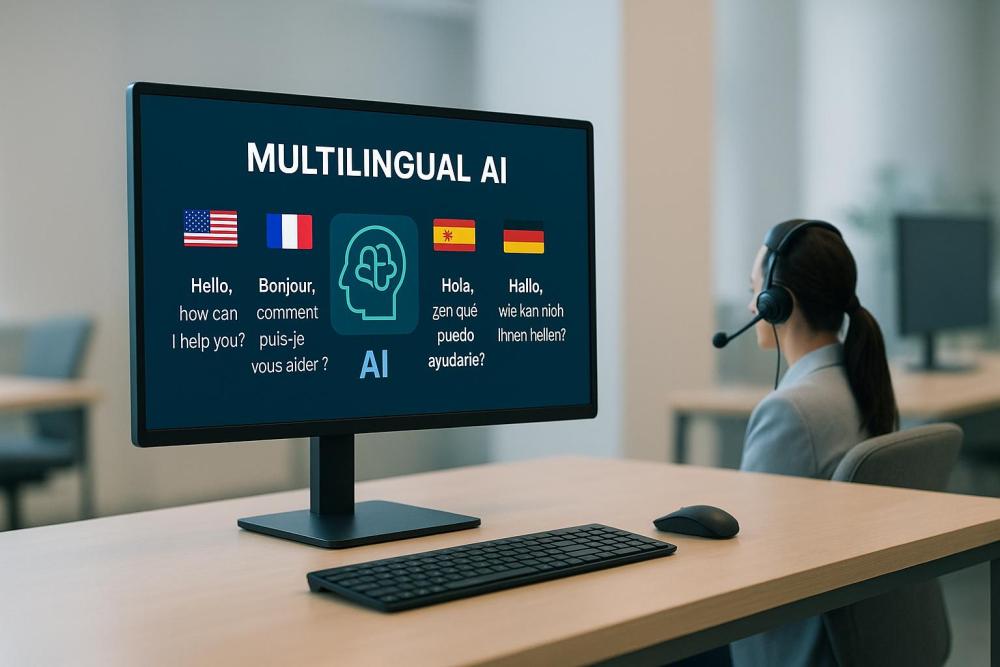
An AI voice agent that supports multiple languages can help operators extend self-service across diverse customer populations.
Sequential Tech states that its AI Voice Agent supports 15+ languages and is designed for multilingual telecom operations.
This can help global providers create a more consistent self-service experience across markets.
Balancing Automation With Human Expertise
The strongest telecom AI strategies do not necessarily remove people from customer service.
Instead, they divide interactions according to complexity.
AI can manage routine and predictable requests. Human agents can then handle conversations that require empathy, judgment, technical expertise, or negotiation.
This human-plus-AI approach allows telecom operators to increase automation while maintaining the human support customers need for more complicated situations.
Measuring AI Voice Agent Performance
Telecom operators should evaluate AI voice automation using measurable operational and customer-experience metrics.
Important KPIs include:
- First-contact resolution
- Average handle time
- Call abandonment rate
- Customer satisfaction
- Escalation rate
- AI resolution rate
- Cost per interaction
- Agent productivity
- Wait time
- Repeat contact rate
Sequential Tech reports that its AI Voice Agent resolves 78% of interactions without escalation and supports deployment within two to four weeks. These are company-reported figures and should be evaluated against each operator's own baseline and use case.
Building a More Efficient Telecom Contact Center
AI voice automation can help telecom operators address two challenges at the same time: rising customer expectations and increasing contact-center operating costs.
By automating routine requests, providing 24/7 availability, integrating with existing telecom systems, and transferring complex cases to human agents with context, an AI voice agent can become an important part of a modern customer-service strategy.
The goal is not simply to automate more calls. It is to make every interaction more efficient while ensuring customers receive the right level of support.
Final Thought
Telecom contact centers are under constant pressure to deliver faster service while controlling operational costs. Traditional IVR systems and manual handling can struggle when routine call volumes increase.
An AI voice agent for telecom provides a more conversational approach to self-service. It can understand customer intent, resolve routine requests, connect with telecom systems, and escalate complex conversations to human agents without losing context.
For operators looking to modernize customer support, AI voice automation can improve availability, reduce wait times, increase agent productivity, and create a more consistent customer experience. Combined with experienced telecom BPO services, Sequential Tech helps telecom operators bring together AI automation and specialized human support to scale customer operations efficiently.


