








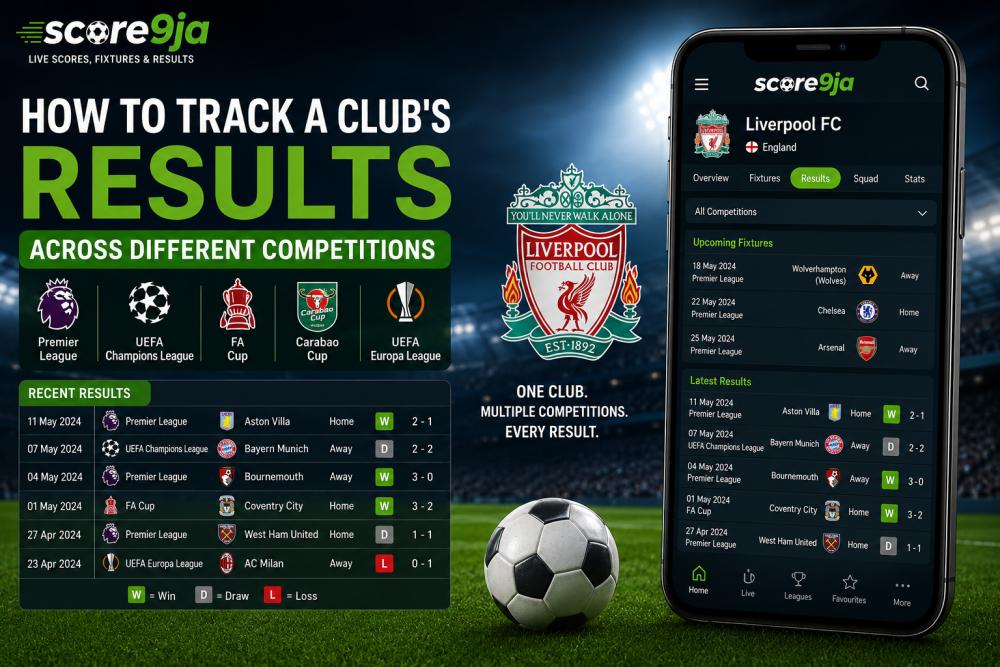
How to Track a Club's Results Across Different Competitions?

Following a football club throughout a season can be more complicated than simply checking its league results.
Many clubs compete in several tournaments at the same time. A team may play a league match at the weekend, a domestic cup tie a few days later and then return to continental competition during the following week.
For supporters, this means a club's overall performance cannot always be understood by looking at one competition alone.
The easiest approach is to track fixtures, results and competition information together so you can see how the club is performing across its complete schedule.
Here are some practical ways to do that.
Start With the Club's Team Page
A dedicated team page is usually the best starting point when you want to follow one club across several competitions.
Instead of checking a separate website for every tournament, a team hub can bring the club's upcoming fixtures and completed results together.
Football fans can use Score9ja club fixtures and results to move into team, fixture and result information across supported competitions.
This makes it easier to answer questions such as:
-
When does the club play next?
-
What was its latest result?
-
Which competition was that match played in?
-
Is the next game a league or cup fixture?
-
How has the team performed recently?
Keeping these details together provides a clearer picture of the club's season.
Separate League Results From Cup Results
One common mistake is treating every result as though it belongs to the same competition.
A club may be participating in a domestic league while also playing in competitions such as:
-
domestic cups;
-
league cups;
-
UEFA Champions League;
-
UEFA Europa League;
-
UEFA Conference League;
-
CAF Champions League;
-
CAF Confederation Cup;
-
other continental tournaments.
Each competition has a different structure and objective.
A 2-0 defeat in a knockout cup match may end the club's participation in that tournament, while a league defeat simply means losing three possible points.
Always check the competition attached to the result before judging what it means.
Look at the Full Fixture Schedule
Results tell you what has already happened.
Fixtures tell you what comes next.
Looking at both together helps supporters understand why a team's performance may change from one match to another.
For example, a club could have the following schedule:
Saturday: Premier League
Wednesday: Champions League
Sunday: Premier League
Thursday: Domestic Cup
That is a demanding sequence.
When supporters only look at the final scores, they may miss the effect that travel, rotation and limited recovery time can have on performances.
Checking the complete fixture schedule provides this additional context.
Follow Recent Results in Chronological Order
When comparing performance across competitions, it helps to view matches in the order they were played.
Consider this example:
-
League — Win
-
Champions League — Draw
-
League — Win
-
Cup — Loss
-
League — Draw
Looking only at the cup defeat might suggest poor form.
Looking at the complete sequence tells a different story.
The team may actually have been performing consistently overall while experiencing one disappointing result in another competition.
Chronological results provide a better picture of momentum than analysing each tournament completely in isolation.
Check Which Competition Each Match Belongs To
Modern football schedules can become crowded, and similar opponents can sometimes meet more than once during a season.
Two clubs might face each other in the league and then meet again in a domestic cup.
That is why the competition label matters.
When checking a result, confirm:
-
competition name;
-
match date;
-
opponent;
-
home or away status;
-
final score.
This prevents confusion between matches that may involve the same teams but have completely different consequences.
Use League Tables for League Matches
League results should normally be considered alongside the league table.
A win or defeat becomes more meaningful when you understand how it changes the club's position.
Three points might:
-
move a club into first place;
-
strengthen a European qualification position;
-
close the gap to a rival;
-
move a team away from relegation.
Cup competitions work differently because progression is usually determined by knockout rounds or group standings rather than a domestic league table.
This is another reason results should be evaluated within the correct competition.
Follow Continental Competitions Separately
Continental football adds another layer to a club's season.
European clubs may participate in UEFA competitions, while African clubs can compete in tournaments organised by CAF.
These fixtures often take place between domestic league games.
Tracking them separately can help you understand whether the club is progressing through the tournament and how continental commitments affect the overall schedule.
A club performing strongly in its domestic league may have very different results in continental competition because the opponents, travel demands and tournament format are different.
Consider Home and Away Results
Another useful way to evaluate a club's performance is to separate home and away matches.
Some teams produce significantly stronger results at their own stadium.
Others may be effective away from home.
When reviewing results across several competitions, note where each match was played.
A difficult run of away fixtures across league and continental football may provide important context for a sequence of weaker results.
Similarly, several consecutive home victories may help explain an improvement in form.
Watch for Fixture Congestion
Competing in several tournaments often creates fixture congestion.
A successful club may have to play every three or four days during particularly busy periods.
This can lead to:
-
squad rotation;
-
player fatigue;
-
fewer recovery days;
-
tactical changes;
-
greater injury risk;
-
different starting line-ups.
These factors do not automatically explain a poor result, but they provide useful context.
When following a club across different competitions, always look at how closely the fixtures are scheduled.
Follow Live Matches When Competitions Overlap
During a busy season, your club may play while other important matches from the same competition are taking place.
Using live football scores can help you monitor both your team's match and relevant results elsewhere.
For example, if several clubs are competing for the same league positions, a supporter may want to follow all of their scores simultaneously.
The same principle applies during the final matches of continental group stages or other competition phases.
Live scores provide a quick way to understand the wider situation without needing to watch every game.
Review Results After Every Matchday
One useful habit is to review the club's recent record after each match.
Ask:
-
What competition was the match in?
-
What was the result?
-
Was it home or away?
-
What does the result mean for that competition?
-
When is the next fixture?
-
Is the next match in the same tournament?
This creates a continuous picture of the season rather than treating every match as an isolated event.
Over time, patterns become much easier to identify.
Do Not Judge Form From One Competition Alone
A team can be struggling in one competition while performing extremely well in another.
For example, a club might have:
League: four consecutive wins
Domestic Cup: eliminated
Continental competition: two draws and one win
Describing the team simply as being "in good form" or "in bad form" would miss important context.
A more useful assessment considers both the club's overall recent results and its record within each specific competition.
Use One Central Football Hub
Following several competitions becomes much easier when club information is connected.
A useful football team page should allow supporters to move between:
Team → Fixtures → Results → Competition → Standings
This eliminates the need to search repeatedly for the same club every few days.
Score9ja team coverage brings together club fixtures, completed results, standings and competition information, making it easier to follow how a team's season develops across different tournaments.
Final Thoughts
Tracking a club's results across different competitions is about understanding the complete schedule rather than focusing on one score.
Start with the club's team page, separate league and cup results, check the competition attached to every match and review fixtures alongside completed results.
League tables can explain the impact of domestic results, while competition-specific information helps put cup and continental matches into context.
Most importantly, look at the club's season as one connected sequence of matches.
By combining fixtures, results, competition information and standings, football fans can get a much clearer picture of how their club is performing across every tournament it enters.


