








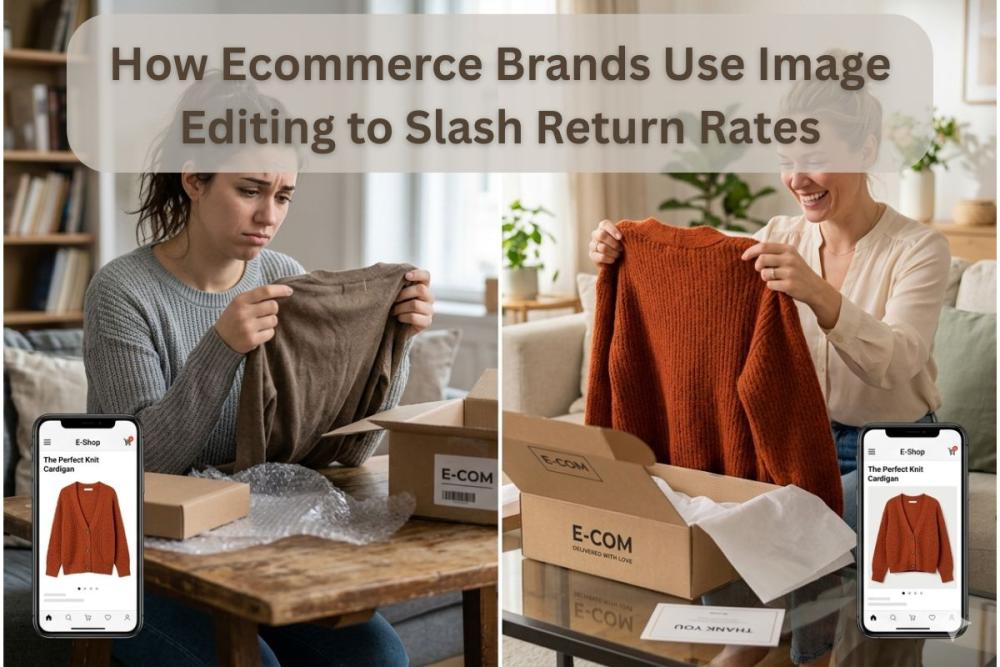
How Ecommerce Brands Use Image Editing to Reduce Product Return Rates

Product returns are a silent profit killer in every successful online business, but ecommerce is booming. Free returns have become standard practice and a fundamental element of today's customer service, but they're a nightmare for retailers. The expenses from reversed logistics, stocking, damaged goods and lost sales can be very crippling to profit margins.
These high return rates are usually attributed to shipping delays, impulsive buyers or sizing charts by retailers. The most common reason for a customer to return a product is, however, quite simple: the product they received is not how they had expected it to look online. It's a problem of expectations as compared to reality. Introducing the unbeatable remedy for this gap: ecommerce image editing.
Closing the Expectation vs. Reality Gap with Better Product Images
The transaction of a "buy" from a consumer is equivalent to a consumer purchasing a commitment. They have no physical contact with the product, don't weigh it in their hands, they don't check it under the light so the only thing they have to go on is what is presented visually to them. When the product is physical and it's different from what it was in digital form, you've lost consumer trust, and it will head back to the shipping box.
The sale of bridging is not about making something look impossibly perfect; it's about making something look like it's fiercely accurate. Good ecommerce image editing is about ensuring that the image you provide in the digital format is an accurate and flawless representation of the real-world product. Post the photoshoot, with control over the visual story, brands can establish realistic expectations right from the first click.
How Accurate Color Correction Reduces Product Returns
“I was thinking this dress is navy blue but in real life it's black.” This is one of the most common complaints in the review areas of online clothing shops is this. The type of lighting used in a studio photoshoot can actually change the true colors of a product, as either a tungsten bulb or a strobe flash. In addition, camera sensors detect color differently than how our eyes do.
To counter that very problem, good ecommerce image editing is crucial, implementing a strict colour correction process. Whether the customers use a blue TV, a white TV or a black one, editors will tweak the hue, saturation, and luminance of each image to ensure the product appears the same in their home as it does on the screen. If the color is accurate, the buyer will be aware of the color they are paying for and the risk of a color return is significantly reduced.
Also Read: How Designers and Editors Can Scale Client Work Without Hiring More Staff
Showcasing Texture and Material Details More Effectively
Selling the "feel" of a product without allowing the customer to touch it is one of the greatest challenges of online selling. The shoppers want to know whether a sweater is full-bodied or scratchy, whether a leather wallet is full-grain or smooth, whether a metal fixture is brushed or polished.
This is where an ecommerce photo retouching service can prove to be very useful for an online brand. Professional retouching is more than simple cropping and colour toning; it accentuates micro details and reveals the tactile qualities of the material. The contrast and highlights are well controlled by expert editors to highlight the weave of a fabric or the natural grain of wood. At the same time, they remove distracting and exaggerated details such as dust, lint or minor manufacturing scuffs, which are made even bigger by the camera lens. The outcome is a picture that can convey texture like you could feel it through your screen.
Helping Customers Understand Product Size and Scale
Misunderstood scale is another big problem that leads to high return rates. If a customer purchases a decorative vase expecting to receive a large floor vase, he/she will be guaranteed a return if the other vase is received as a table ornament.
Many consumers are visual learners and skim the text in the product description and many also expect an exact size which is required. Can help to set the scale and context with advanced image editing for ecommerce. Editors use techniques such as creating natural shadows, adding realistic depth and dimension to the product. In addition, editors can easily merge products into lifestyle or zoom them to scale them to fit against recognized reference objects. This visual information helps the customer to understand the size and scale of the item before they click on the checkout page.
The Hidden ROI of Professional Ecommerce Image Editing
Returns are an expense, and that's more than the shipment. Add the cost of processing the return, the repackaging, and the fact that it may end up being unsellable and the financial drain is considerable.
It may appear as an extra operational cost, but if you invest in quality post-production, you are making a huge cost-saving move. The ROI of ecommerce image editing goes sky high if a brand can decrease the return rate by just 2 or 3% points by simply showing more accurate pictures of the products. You're not only paying for nicer photos; you're paying for a policy of insurance that you don't have to deal with if you could have avoided it. It simplifies the buying process, improves the transparency of the shopping experience and safeguards the profit margin.
Final Thoughts: Why Better Product Images Build Customer Trust
Today's digital consumer is very discerning. They want transparency, accuracy, and quality every step of the way in their shopping journey. When it comes to online retailers, high accuracy and clear images are the keys to establishing trust among their customers and significantly reducing return rates. In a catalog of thousands of products, though, it's essential to have a reliable and scalable workflow to get this degree of visual consistency. Companies such as Visuals Clipping is trusted by many leading brands to provide their strict post-production requirements so that each and every pixel matches the real-life product. At the end of the day, if a brand puts a significant effort into professional ecommerce image editing, they're not simply uploading a photograph, they're making a commitment to their customer.


