






How to Choose the Right Domain Rating Checker for Your Business

How do you know if your website has enough authority to compete, or if you are just guessing with SEO tools? Many teams pick a tool because it looks popular, then they build plans around numbers they do not fully trust. A domain rating checker should reduce guesswork, but only if it fits your goals and the way you report results.
Start With The Business Outcome, Not The Score
Most businesses adopt an authority tool for one of three reasons: qualify link prospects, estimate keyword difficulty, or explain progress to leadership. Start there. If the tool cannot support your outcome, its score becomes noise.
If you run a local brand, you may care more about trend direction and competitor gaps than perfect precision. If you sell nationally, you may need deeper link discovery, history, and exports for clean reporting. When teams at DoorEZ reviewed their SEO stack, they picked tools that matched pipeline goals, not vanity charts.
Your first filter should be how the tool helps you decide:
- Which pages deserve links first
- Which keywords match your current authority range
- Which competitors win because of links, not content depth
The Two Key Factors Behind Ranking Strength
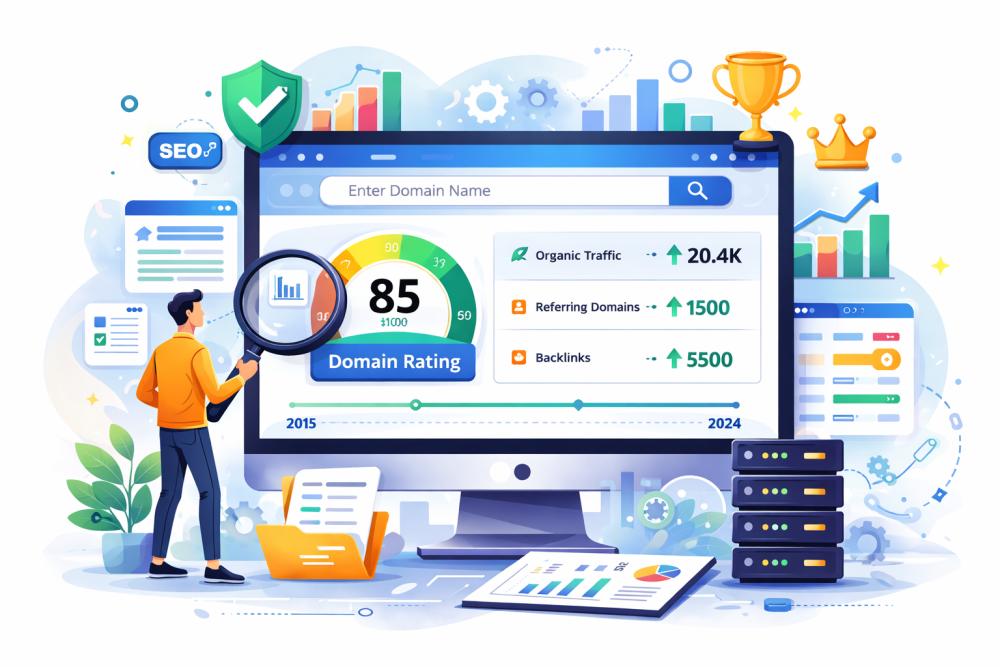
A solid evaluation starts with definitions. A website SEO checker inspects on-page and technical health. It reviews titles, headers, internal linking, crawlability, speed basics, and common errors. A domain rating checker focuses on off-site authority, based on referring domains, link quality signals, and link distribution patterns.
Treat these as two layers of one system. Technical quality decides how well link equity moves through your site. Authority decides how much competition you can handle in search results. If your chosen tool cannot help you communicate both layers, your team keeps fixing the wrong thing first.
Shortlist Tools With A Fit Table
Use this table to narrow options without getting pulled into marketing copy. Keep each row tied to decisions you make each week.
|
Feature |
What To Check |
Why It Matters |
|
Link discovery |
Referring domains found in your niche |
Blind spots weaken outreach plans |
|
Refresh rate |
How often links and scores update |
Slow updates hide momentum |
|
Quality filters |
Labels for spam signals and link types |
Cleaner prospecting and cleanup |
|
Competitor gaps |
Side-by-side link gap views |
Faster prioritization of wins |
|
Reporting |
PDF, CSV, API, scheduled exports |
Easier stakeholder updates |
|
Limits |
Projects, seats, and history access |
Prevents surprise restrictions |
Validate Before You Commit
Do not trust a score until you validate the inputs. Run checks across three domains: your site, a known competitor, and a neutral reference site in your industry. A good domain rating checker should show link sources you can verify, not just a number.
Look for consistency in these areas:
- It finds your top known backlinks
- It surfaces link losses after removals
- It separates relevant mentions from directory noise
- It allows page-level views, not only the root domain
Use Authority Metrics To Drive Action
Treat DR-style metrics as steering signals, not the destination. Use them to pick targets you can win. If your authority sits low, focus on long-tail queries, strong internal linking, and tight topic clusters that earn natural references. If your authority rises, widen into tougher terms and push for links to pages that already convert.
This is where a domain rating checker earns its keep. Connect the score to a workflow: match authority to keyword tiers, identify pages that need internal link support, and track growth through quality referring domains rather than raw backlink volume.
Smart teams watch relevance and link velocity. A spike from unrelated sites does not hold rankings. A steady flow from relevant sites supports growth and reduces ranking swings.
Pricing And Support Details People Miss
Pricing works when limits match your usage. Check caps on projects, tracked keywords, exports, and history access. Check how the vendor handles discrepancies and support tickets. Many platforms lock key views behind higher tiers, so read the feature list like a contract.
Prefer reporting that explains next steps in plain English and ties technical fixes to authority growth.
Conclusion
Choose one primary platform you will use each week, then pair it with a lightweight on-page auditor for technical checks. Run a short trial with a checklist, then decide based on repeatable workflows, not feature overload.
When your process links site health to authority gains and keyword wins, your strategy starts to feel predictable, like consulting, and website SEO checker becomes a decision tool instead of a score to chase.


