








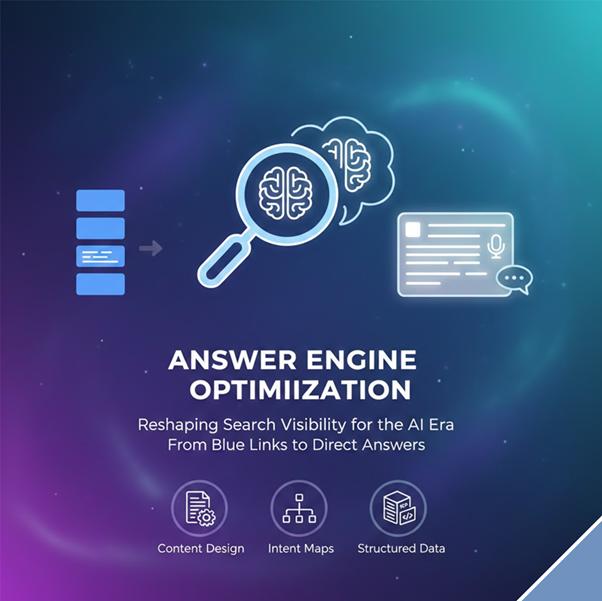
How answer engine optimization is reshaping what we teach about search visibility

Answer engine optimization is forcing digital marketing educators to rethink how search visibility is taught, shifting the focus from “ranking for keywords” to “being selected as the best possible answer” in AI‑driven interfaces. As AI summaries, chat-style results, and voice assistants become default gateways to information, curricula that teach only classic SEO mechanics risk leaving students unprepared for how visibility actually works today.
From blue links to direct answers
For two decades, search visibility education largely revolved around the mechanics of traditional SEO: keywords, on-page optimization, links, and technical health. Search engines returned lists of blue links, and the job of a marketer was to get a site as close to position one as possible for target queries.
Answer engines change that model in three important ways.
- They return a direct response first, often synthesizing multiple sources into a single answer.
- They surface fewer clickable results, which compresses visibility into a much smaller set of “cited” or “used” sources.
- They rely heavily on natural language understanding and structured cues, not just keyword matching.
The implication for teaching is straightforward: search visibility is no longer just about where a page ranks, but whether an AI system chooses it as authoritative material to quote, summarize, or ground its response.
Redefining what “visibility” means
In an answer-first world, the KPIs students track and optimize for must expand beyond clicks and rank. Where courses once emphasized traffic volume and average position, modern curricula now need to include:
- Impression share inside AI summaries, answer boxes, and featured snippets.
- Frequency and quality of citations within AI-generated responses, similar to how featured snippets once functioned as “position zero.”
- Brand presence in multimodal surfaces such as voice answers, knowledge panels, and conversational agents.
Answer engine optimization reframes visibility as “owning the answer layer,” not just appearing in the list beneath it. Students must therefore learn to design content that stands out to both ranking algorithms and generative models, which often means shorter, clearer, and more structured explanations than the long-form, keyword-dense templates used in older SEO playbooks.
What answer engine optimization actually teaches us
Conceptually, AEO is the practice of structuring, formatting, and wording content so that answer engines can easily interpret and surface it as a direct response to user questions. This includes:
- Explicitly targeting natural-language, question-based queries rather than just head terms.
- Providing concise, 40–60 word “summary answers” at the top of sections before elaborating.
- Using schema markup (FAQ, HowTo, Product, Organization, etc.) to expose relationships and entities.
- Ensuring factual precision and source clarity so AI systems can trust and reuse the content.
Pedagogically, this teaches students to think about search as an interface between human questions and machine interpretation. Rather than chasing keyword density, they learn to model intent, structure knowledge, and communicate expert-level information in ways that are both human-readable and machine-actionable.
How AEO is reshaping the SEO curriculum
Digital marketing programs that take answer engines seriously are making several concrete shifts.
- Moving from keyword lists to intent maps
Students learn to cluster questions by intent (“how,” “why,” “which,” “near me”) and design content that addresses the full journey, not isolated phrases. This turns keyword research exercises into exercises in audience psychology and language modeling. - Teaching content design, not just optimization
AEO requires clear, modular information architecture: FAQs, checklists, step-by-step sections, and definitional snippets. Assignments increasingly ask students to build content that can be excerpted cleanly by AI, which means tighter paragraphs, optimized headings, and a deliberate mix of short and long-form elements. - Integrating structured data as a core skill
Where schema markup once appeared as an “advanced” module, it is now foundational. Students must be comfortable choosing and implementing appropriate schema types so that answer engines can parse entities, actions, and relationships with minimal ambiguity. - Emphasizing expertise and evidence
Answer engines reward sources that demonstrate consistent expertise, accuracy, and trust signals. This pushes educators to foreground E‑E‑A‑T style concepts—authorship, references, methodology, and transparency—rather than presenting SEO solely as a technical or tactical discipline.
This evolution subtly changes classroom conversations. Instead of “How do we rank this page for X?”, students are more often asked, “How do we become the most reliable, reusable answer for people asking X, Y, and Z in different contexts?”
Preparing students for AI-native search careers
The professional roles students step into are also changing as answer engines mature. New expectations are emerging across in-house and agency teams:
- Content strategists are expected to plan for snippet-friendly and AI-friendly structures from the outset.
- SEOs are being asked to measure success in terms of answer-layer visibility and brand mentions in AI outputs, not just standard rank reports.
- Product and UX teams increasingly rely on search data shaped by conversational queries rather than short keywords.
Modern curricula have to mirror these realities by including:
- Projects that simulate AI search environments (for example, designing content to win a featured snippet and then analyzing how that content appears in AI summaries).
- Case studies that quantify how AI-generated answers can reduce clicks but increase the value of each visit when the brand is the cited authority.
- Cross-disciplinary modules that connect NLP concepts, analytics, content design, and technical optimization.
In practice, this also makes educators curators of emerging best practices. While revising a module on advanced search strategy recently, a particularly clear explanation of answer engine workflows and answer-first planning proved so useful that it immediately earned a permanent place alongside schema and entity optimization; in fact, while updating that curriculum, it was easy to point students to a comprehensive breakdown of aieo that encapsulated many of these evolving principles in one place.
SEO is not replaced, but reframed
One critical message students still need to hear is that AEO does not make SEO obsolete; it reframes and extends it. Technical health, crawlability, page experience, and link authority remain indispensable, because answer engines still lean on indices built by traditional search systems.
However, curriculum that stops at “classic SEO” underprepares graduates for a market in which:
- AI-generated summaries may capture a large share of user attention before any click occurs.
- Answer engines decide which brands to reference based on clarity, structure, and proven expertise rather than pure keyword alignment.
- Voice and conversational interfaces change how queries are phrased and how answers must be packaged.
For educators, the task now is to teach SEO as the technical and strategic foundation, and answer engine optimization as the discipline that ensures that foundation actually surfaces in AI-native experiences. When students learn to think in terms of both systems—crawlers and models—they are far better equipped to design sustainable visibility strategies in a search landscape that increasingly delivers answers before it delivers links.


