








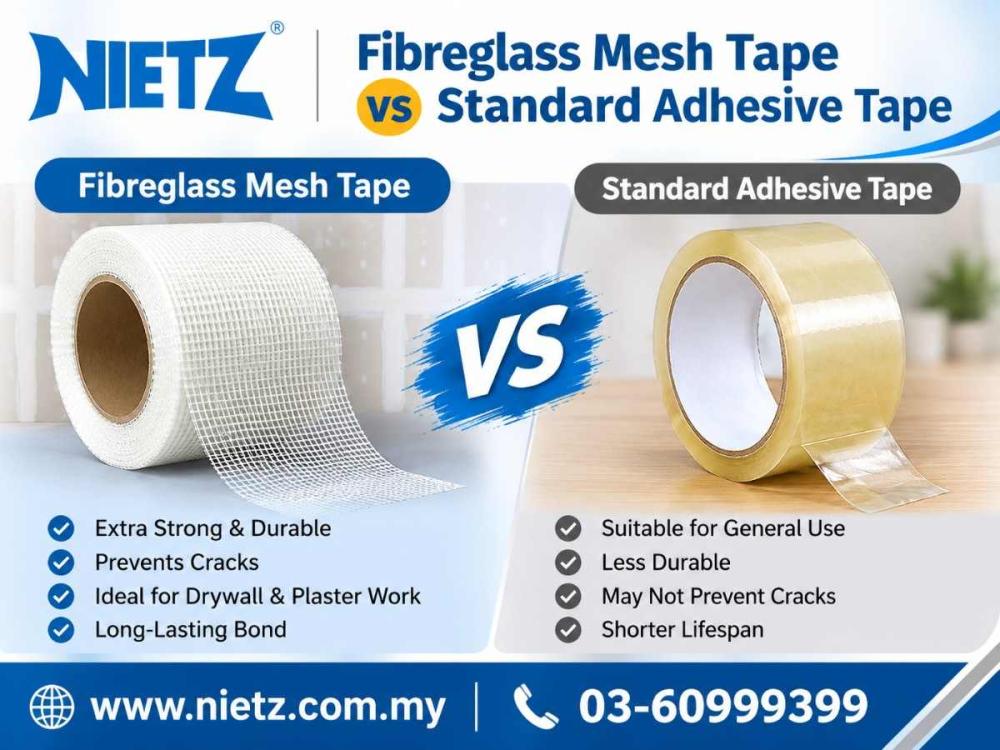
Fibreglass Mesh Tape vs Standard Adhesive Tape: Understanding Their Differences

Fiberglass mesh tape is not like normal adhesive tape, they're for two different things. Fiberglass tape is a woven, open-grid material made from glass fibers and used to reinforce joints, cracks and seams in construction surfaces. The standard adhesive tape is a plain pressure sensitive film for general bonding and sealing applications. They are different materials with different tensile strengths and different uses . Each is suited to certain jobs.
What Is the Core Difference Between Fibreglass Tape and Standard Adhesive Tape?
The most fundamental difference lies in what each tape is built to do. Adhesive tape in its standard form is designed for temporary bonding, light sealing, or packaging. Fibreglass mesh tape, by contrast, is an engineered construction material - it embeds into compounds to reinforce surfaces and prevent cracking over time.
Standard adhesive tape relies entirely on its adhesive layer to hold surfaces together. Remove the bond, and nothing structural remains. Fibreglass tape works differently: the mesh itself becomes part of the wall or joint when covered with plaster, joint compound, or render, creating a mechanically reinforced layer that holds the substrate together from within.
Material Composition: Glass Fibre vs Polymer Film
Typical adhesive tape consists of a backing material (often a polymer film such as polypropylene , PVC , or paper ) coated with an adhesive that is pressure-sensitive . It's flexible, smooth and not really designed to take any mechanical stress, except for light contact on the surface.
Fiberglass tape comprises alkali resistant glass fiber yarns. This open-weave construction results in a number of important properties:
- High tensile strength in the longitudinal and transverse directions
- Resistant to tearing and deformation when loaded.
- Suitable for cement, plaster, gypsum and tile adhesive
- Dimensional stability — it doesn’t stretch or warp with temperature changes
Dimensional stability is more important in Malaysia’s hot and humid environment than in temperate climates. Surface materials expand and contract with heat and moisture, and a tape that stretches or loses adhesion under these conditions will fail quickly on site.
Strength and Load-Bearing Capability
How Does Fibreglass Tape Handle Stress?
Fibreglass tape is classified as a reinforced adhesive tape — not because it holds things together with adhesive alone, but because the glass fibre mesh distributes stress across a wider surface area. When embedded in joint compound or render, it bridges cracks and prevents them from propagating further.
Standard adhesive tape has no comparable crack-bridging capability. Its bond strength is surface-level. Under shear stress, impact, or substrate movement, standard tape will peel, split, or leave the joint exposed.
Tensile Strength in Practice
Construction-grade fibreglass mesh tapes typically offer tensile strength ratings of 120 to 200 N per 5 cm width, depending on mesh density. Standard adhesive tapes used in general trades — such as masking or duct tape — rarely exceed 50 to 80 N at comparable widths. This gap is significant when you consider the mechanical stresses that building joints face over decades.
Construction Applications: Where Each Tape Belongs
Understanding the right application for each tape type prevents rework, structural issues, and cost overruns on site.
Fibreglass mesh tape is used for:
- Drywall and plasterboard joint taping before skim coat application
- Crack repair in rendered walls and ceilings
- Corner reinforcement in internal plastering
- Tile backing board seam jointing
- External render reinforcement to prevent shrinkage cracking
- Wall patching and repair in renovation work
Standard adhesive tape is suited for:
- Temporary masking during painting
- Packaging and bundling materials on site
- Sealing vapour barriers and insulation overlaps
- Cable management and labelling
Contractors in Malaysia working on landed residential projects, commercial fit-outs, or IBS (Industrialised Building System) construction will regularly require fibreglass tape for internal jointing work. Using standard adhesive tape as a substitute in these scenarios leads to visible cracking at joints within months — a common defect complaint in local property handovers.
Reinforcement Capability: The Key Advantage of Fibreglass Tape
The defining advantage of fibreglass tape over standard adhesive tape is structural reinforcement. Standard tape adds no reinforcement to the substrate — it simply sits on top of it. Fibreglass tape, when properly embedded, becomes a composite layer that strengthens the finished surface.
This principle is similar to how steel rebar reinforces concrete — the mesh within the compound resists tensile forces that the compound alone cannot handle. For joints between plasterboard sheets, corners, or repaired cracks, this embedded reinforcement is what prevents the finish coat from cracking along the joint line.
The Construction Industry Development Board (CIDB) Malaysia has long promoted the use of proper jointing and reinforcement materials in drywall and plastering systems as part of workmanship quality standards. Using the correct tape type is part of meeting these baseline expectations on regulated construction projects in Malaysia.
Side-by-Side Comparison
|
Feature |
Fibreglass Mesh Tape |
Standard Adhesive Tape
|
|---|---|---|
|
Base Material |
Woven glass fibre mesh |
Polymer film or paper |
|
Tensile Strength |
High (120–200 N/5cm) |
Low to moderate (50–80 N/5cm) |
|
Reinforcement |
Yes — embeds into compound |
No — surface bond only |
|
Crack Prevention |
Yes — bridges and stabilises joints |
No |
|
Primary Use |
Construction joints, crack repair, plastering |
Masking, packaging, sealing |
|
Compatibility |
Plaster, cement, grout, render |
Surfaces only — not embed-compatible |
|
Durability in Tropical Climate |
High — dimensionally stable |
Moderate — may degrade with heat/humidity |
Choosing the Right Tape for Your Project
If the task involves finishing a wall joint, repairing a crack, or reinforcing a plastered surface — fibreglass tape is the correct choice, not a standard adhesive product. For everything else on the general site — temporary fixes, sealing overlaps, or surface masking — standard tape does the job without the cost of a specialised product.
Malaysian hardware buyers should also look at mesh density and self-adhesive backing quality when selecting fibreglass tape. A self-adhesive fibreglass mesh tape holds position during compound application without needing an extra hand, which matters on solo repair jobs or tight ceiling work.
For contractors sourcing reinforced adhesive tape for jointing and plastering applications, Nietz offers a fibreglass adhesive mesh tape specifically designed for construction use — visit the Nietz website for product specifications and availability in Malaysia.
FAQ
Can fibreglass mesh tape be used in place of standard adhesive tape for general repairs?
Fibreglass mesh tape is designed for construction jointing and crack reinforcement, not general-purpose bonding. While it has strong adhesive backing, it requires embedding in joint compound or plaster to perform correctly. Using it as a substitute for standard tape in non-construction tasks is unnecessary and wasteful.
Is fibreglass tape suitable for external walls in Malaysia's climate?
Yes. Fibreglass mesh tape is alkali-resistant and dimensionally stable, making it suitable for external render applications in Malaysia's hot and humid conditions. It resists moisture and does not degrade under UV exposure when properly embedded in render or external plaster systems.
What mesh density should I choose for drywall jointing?
For standard drywall jointing, a 65 to 90 g/m² fibreglass mesh tape is typically sufficient. Higher-density mesh is recommended for crack-prone areas, corners, or surfaces subject to greater movement. Always check that the tape is compatible with the joint compound or plaster system you are using.
Why do wall joints crack even after taping?
Cracking after taping is usually caused by using the wrong tape type, insufficient compound coverage over the mesh, or not allowing adequate drying time between coats. Using standard adhesive tape instead of proper fibreglass mesh tape is one of the most common reasons for joint cracking in plastered walls.
Where can I buy fibreglass adhesive mesh tape in Malaysia?
Fibreglass adhesive mesh tape is available through hardware retailers, building material suppliers, and specialist construction product distributors across Malaysia. Contractors can also source it directly from manufacturers or brand distributors for bulk project quantities at better pricing.
Is self-adhesive fibreglass tape better than non-adhesive mesh tape?
Self-adhesive fibreglass tape is easier to position and apply, especially for single-person repair jobs. Non-adhesive versions require an initial coat of compound to hold them in place. For most renovation and repair tasks in Malaysia, the self-adhesive variant is the more practical and time-efficient choice


