








Indonesia Gaming Market Size, Growth, Trends, and Forecast 2026-2034

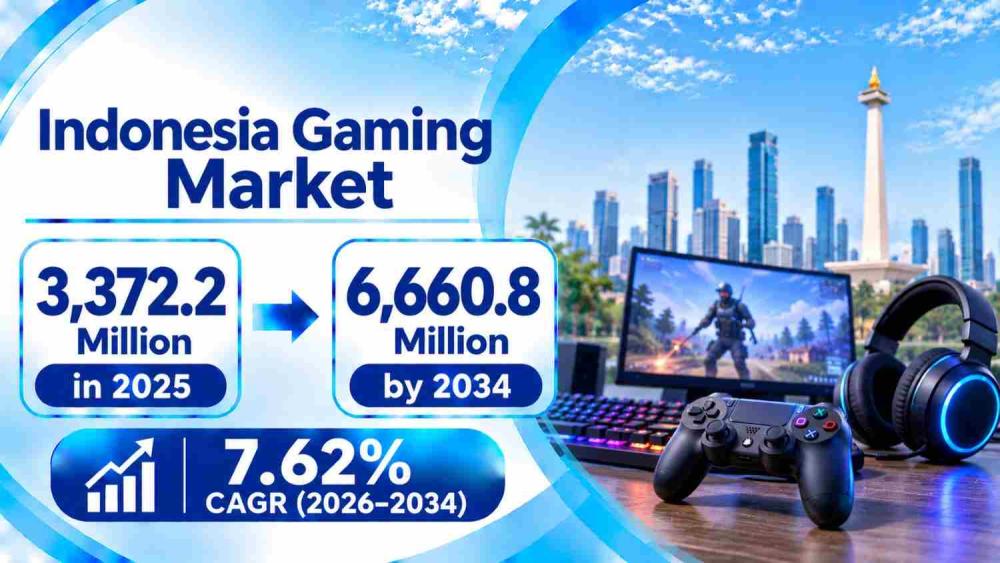
IMARC Group, a leading global market research and management consulting firm, has published its latest market intelligence report on the Indonesia Gaming Market. The Indonesia gaming market size reached USD 3,372.2 Million in 2025 and is projected to reach USD 6,660.8 Million by 2034, exhibiting a CAGR of 7.62% during 2026-2034. Growth is being driven by the country's young population with high mobile penetration, rising disposable incomes, the growing popularity of esports, government incentives for the digital economy and enhanced internet infrastructure that spur local development and foreign investment.
Gaming is now one of the most visible parts of Indonesia's digital culture, with a young, mobile-first population turning mobile games, live streams and esports into everyday entertainment. The country has become a global stronghold for titles such as Mobile Legends: Bang Bang and Free Fire, and the M7 World Championship held in Jakarta in January 2026 drew a peak of more than 5.6 million concurrent viewers. At the same time, digital wallets such as GoPay, OVO, DANA and ShopeePay are making in-game purchases easy for the unbanked and underbanked, while international publishers such as Krafton are localizing launches for Indonesian players. The policy environment is also evolving: the government is backing a national game industry through Presidential Regulation No. 19 of 2024 and a mandatory game rating system, although the rating rollout was suspended in April 2026 after a contested launch and is being re-evaluated. Combined with a deep pool of local talent and growing interest in turning Indonesian IP into games, these forces are shaping a durable, long-term growth path across Java, Sumatra, Kalimantan, Sulawesi, and other regions.
Indonesia Gaming Market at a Glance:
- Market Size (2025): USD 3,372.2 Million
- Market Forecast (2034): USD 6,660.8 Million
- Growth Rate (2026-2034): CAGR of 7.62%
- Base Year: 2025 | Historical Period: 2020-2025 | Forecast Period: 2026-2034
How AI is Reshaping the Future of the Indonesia Gaming Market
- Fintech Embedded in Gaming Ecosystems: Digital payment systems are now embedded in most gaming platforms, with wallets such as GoPay, OVO, DANA and ShopeePay enabling in-app purchases, subscriptions and microtransactions, while cashback, vouchers and bundled offers are customized for gamers, and digital wallets accounted for 34% of all transactions in 2023 according to an industry report cited in the report.
- Automated Self-Assessment Game Ratings: The Indonesia Game Rating System, launched on 11 October 2025 and developed in collaboration with the International Age Rating Coalition, lets publishers obtain an age rating through an online self-assessment rather than manual review, a model that depends on automated, data-driven classification, although its April 2026 rollout on Steam proved contentious.
- Mobile-First Esports Streaming and Data Companions: Esports viewing in Indonesia increasingly runs on mobile phones, with MPL Indonesia placing official restreamers within its ecosystem and viewers moving between video, live statistics, community chat and results apps, creating a data-rich layer around live competition.
Grab a sample PDF of this report: https://www.imarcgroup.com/indonesia-gaming-market/requestsample
Indonesia Gaming Market Trends and Drivers:
Demand for games across Indonesia is being underpinned by a large youth population. The market benefits from 64.16 million people aged 16 to 30, accounting for 23.18% of the total population, a group that is the core audience for mobile and online games, with high daily screen time, strong interest in digital entertainment and early adoption of new platforms. Mobile-first usage dominates thanks to affordable smartphones and relatively low mobile data costs, and young consumers are also more inclined to try new genres, payment schemes and interactive modes such as live streaming and esports, shaping the virality and life cycle of new titles through peer influence and social media.
The market's structural differentiator is the integration of fintech and gaming. With a large share of the population still unbanked or underbanked, traditional card payments have limited reach, and digital wallets have emerged as critical enablers of in-app purchases and microtransactions. Cooperation among fintech companies and game publishers has led to bundled promotions and wallet-linked digital content, while fintech apps themselves are adding rewards and mini-games, normalizing digital payments among young users and driving monetization as financial literacy and digital trust rise.
A third driver is esports, which turns gaming into a mass spectator sport. The MLBB M7 World Championship, held in Jakarta from 3 to 25 January 2026, peaked at more than 5.68 million concurrent viewers according to MOONTON Games, and MPL Indonesia Season 17 ran from March to June 2026, ending with Bigetron by Vitality defeating ONIC ID 4-1 in the grand final. Esports has also been positioned as a cultural export platform, with six Indonesian-developed IPs being integrated into the MLBB esports ecosystem, a dynamic that is set to intensify over the coming decade.
Government Schemes and National Digital Economy Programs Driving Demand:
- Presidential Regulation No. 19 of 2024 on Acceleration of the National Game Industry: The regulation sets out a framework to improve funding and financing access, market access and tax facilities for game developers and publishers, including IP-based financing, with foreign investors allowed up to 100% ownership in game development and publishing, while local partnership and local content features are still to be implemented.
- Game Classification Rules and the Indonesia Game Rating System (IGRS): Communication and Digital Ministry Regulation No. 2 of 2024 took effect on 24 January 2026, requiring every game advertised, distributed or accessible in Indonesia to hold an IGRS rating, but the rollout was postponed on 17 April 2026 after criticism of incorrect ratings on Steam and a data breach, with the ministry targeting reactivation in 2026 after stakeholder evaluation.
- Ministry of Creative Economy Partnerships: In June 2025, the Ministry of Creative Economy announced cross-sector partnerships, including collaboration with global developers such as Riot Games, to integrate gaming with music, film, illustration and local IP development, aiming to position Indonesia as a key hub for the global creative economy.
- National Esports Programs: The national esports federation PB ESI renewed its commitment with MOONTON Games to build a more structured national MLBB team program ahead of the Esports Nations Cup 2026 in Riyadh and the 2026 Asian Games, supporting competitive and talent pipelines.
- Digital Economy Incentives and Connectivity: According to the report, government incentives for the digital economy and improved internet infrastructure are encouraging local development of games and foreign investment in gaming.
Indonesia Gaming Market Industry Segmentation:
The report has segmented the market into the following categories:
Breakup By Device Type:
- Consoles
- Mobiles and Tablets
- Computers
The report provides a detailed breakup and analysis of consoles, mobiles and tablets, and computers, reflecting a market where mobile-first usage dominates among young players thanks to affordable smartphones and low mobile data costs, while computers and consoles serve PC and premium gaming audiences.
Breakup By Platform:
- Online
- Offline
The report provides a detailed breakup of online and offline platforms, with online play, live streaming, digital storefronts and esports driving engagement, supported by digital wallets and in-app payment systems.
Breakup By Revenue Type:
- In-Game Purchase
- Game Purchase
- Advertising
The report provides a detailed breakup across in-game purchases, game purchases and advertising, with in-app purchases, subscriptions and microtransactions made easier by digital wallets, cashback and bundled offers designed for gamers.
Breakup By Type:
- Adventure/Role Playing Games
- Puzzles
- Social Games
- Strategy
- Simulation
- Others
The report provides a detailed breakup across adventure and role-playing games, puzzles, social games, strategy, simulation and others, with young players experimenting across genres and interactive modes and esports titles shaping popular demand.
Breakup By Age Group:
- Adults
- Children
The report provides a detailed breakup of adults and children, a split that has gained regulatory importance as the government introduces age classification, with Niko Partners reporting that nearly 90% of players in Indonesia believe governments should regulate content for children.
Breakup By Region:
- Java
- Sumatra
- Kalimantan
- Sulawesi
- Others
The report provides a comprehensive regional analysis across Java, Sumatra, Kalimantan, Sulawesi and others, with Java hosting major esports venues such as the Jakarta International Velodrome, while mobile-first access brings players in outer islands into the market.
Competitive Landscape:
The report provides a comprehensive analysis of the competitive landscape, covering market structure, key player positioning, top winning strategies, the competitive dashboard and the company evaluation quadrant, along with detailed profiles of major companies. Key players include:
- Moonton (ByteDance)
- Garena (Sea Limited)
- Tencent Games
- NetEase Games
- Krafton
- Agate International
- Touchten Games
Global publishers anchor the market through hit titles, with Mobile Legends: Bang Bang from Moonton and Free Fire from Garena leading engagement and esports, Krafton expanding its mobile portfolio in Indonesia, and local studios such as Agate International and Touchten Games developing games and local IP.
Market Concentration Analysis:
- The Indonesia gaming market is concentrated at the top, with a few global publishers and flagship titles, notably Moonton's Mobile Legends: Bang Bang and Garena's Free Fire, anchoring player engagement and esports, with Indonesia accounting for around 44% of Mobile Legends' global downloads according to Sensor Tower data cited by Digital in Asia.
- Fragmentation increases among local studios, indie developers and PC and console publishers, where companies such as Agate International and Touchten Games compete across casual, mobile and local-IP titles, creating a structure where global publishers dominate revenue and viewership while local developers focus on niche genres, local content and co-development.
- Strategic expansion and policy shifts are reshaping the competitive balance, exemplified by Krafton's June 2025 launch of Abyss of Dungeons in Indonesia, the upcoming local partnership and local content provisions of Presidential Regulation No. 19 of 2024, and the integration of six Indonesian-developed IPs into the MPL Indonesia ecosystem.
What Does The Full Report Cover?
- Historical, current, and forecast market size for the Indonesia gaming market from 2020 to 2034
- Market breakup by device type, platform, revenue type, type, age group, and region
- Regional analysis covering Java, Sumatra, Kalimantan, Sulawesi, and Others
- Key growth drivers, challenges, and opportunities shaping the market
- Porter's Five Forces analysis and value chain assessment
- Competitive landscape, market structure, and player positioning
- Detailed profiles of major gaming companies in Indonesia
Recent News and Developments in the Indonesia Gaming Market
- August 2026: Indonesia's Ministry of Communication and Digital Affairs confirmed that reactivation of the Indonesia Game Rating System is targeted for completion in 2026 after a comprehensive evaluation involving the gaming industry and parent communities.
- June 2026: MPL Indonesia Season 17 concluded on 14 June, with Bigetron by Vitality defeating ONIC ID 4-1 in the grand final to win its first MPL Indonesia title.
- April 2026: Indonesia postponed the implementation of its game rating system on 17 April after public scrutiny of incorrect IGRS ratings displayed on Steam, which the ministry said were not official results.
- January 2026: The MLBB M7 World Championship was held in Jakarta from 3 to 25 January and peaked at more than 5.68 million concurrent viewers, while Ministerial Regulation No. 2 of 2024 on game classification took effect on 24 January.
- June 2025: KRAFTON launched its mobile extraction RPG Abyss of Dungeons in Indonesia on 11 June with Indonesia-specific features and TikTok campaigns, and on 19 June Indonesia's Ministry of Creative Economy announced cross-sector partnerships, including with Riot Games, to support the national gaming industry.
Note: If you require specific details, data, or insights that are not currently included in the scope of this report, we are happy to accommodate your request. As part of our customization service, we will gather and provide the additional information you need, tailored to your specific requirements. Please let us know your exact needs, and we will ensure the report is updated accordingly to meet your expectations.
Key Questions This Report Answers
- How big is the Indonesia gaming market and what is its growth outlook through 2034?
- What are the key growth drivers, challenges, and opportunities in the Indonesia gaming market?
- How is the market split by device type, platform, revenue type, type, age group, and region?
- How are the young population and mobile-first usage shaping demand?
- How are fintech integration, digital wallets, and esports influencing monetization?
- Who are the key players in the Indonesia gaming market, and how is the competitive landscape evolving?
- How are government regulations such as the game rating system and the national game industry framework shaping the market?
About Us
IMARC Group is a global management consulting firm that helps the world's most ambitious changemakers to create a lasting impact. The company provides a comprehensive suite of market entry and expansion services. IMARC offerings include thorough market assessment, feasibility studies, company incorporation assistance, factory setup support, regulatory approvals and licensing navigation, branding, marketing and sales strategies, competitive landscape and benchmarking analyses, pricing and cost research, and procurement research.
Media and Sales Contact
IMARC Group
Email: sales@imarcgroup.com
United States: +1-201-971-6302
India: +91-120-433-0800
United Kingdom: +44-753-714-6104


