








Indonesia Electric Two-Wheeler Market Size, Share, and Report 2026-2034

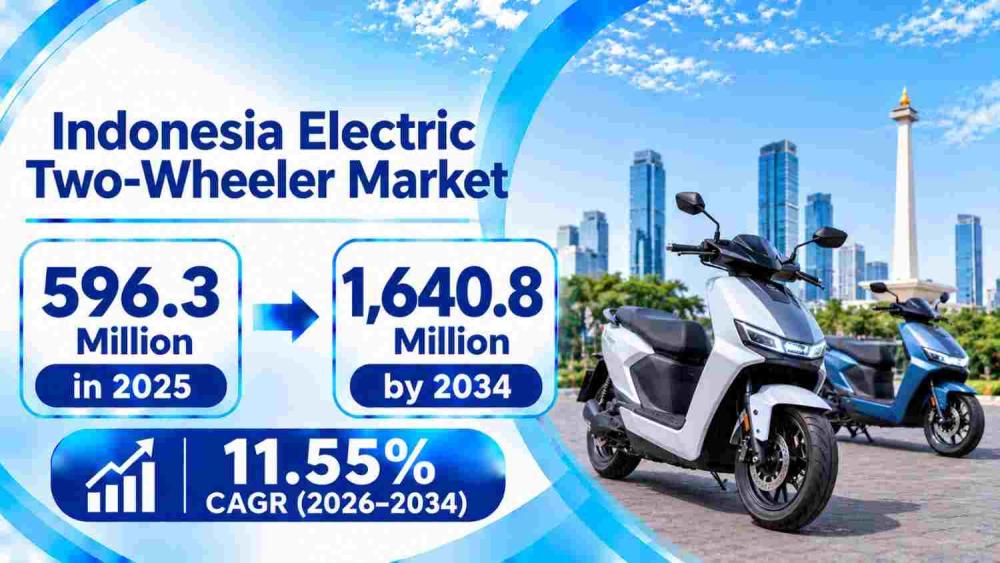
IMARC Group, a leading global market research and management consulting firm, has published its latest market intelligence report on the Indonesia Electric Two-Wheeler Market. The Indonesia electric two-wheeler market size reached USD 596.3 Million in 2025 and is projected to reach USD 1,640.8 Million by 2034, exhibiting a CAGR of 11.55% during 2026-2034. Growth is being driven by rising fuel prices, supportive government policies promoting electrification, and growing environmental concerns pushing for low-emission mobility solutions across the country's dense urban centers.
Electric two-wheelers remain one of the fastest-growing segments of Indonesia's automotive economy, underpinning the country's shift away from a motorcycle fleet that accounts for the majority of urban vehicle emissions. As Indonesian authorities push ahead with the Low Carbon Emission Vehicle roadmap and local component manufacturing incentives, demand for electric scooters and motorcycles is climbing steadily across Java, Sumatra, and the wider archipelago. At the same time, both domestic manufacturers and new entrants are investing heavily in smart, connected vehicle technology, from autonomous-capable electric motorcycles to app-integrated ride-hailing fleets, positioning Indonesia as an emerging electric two-wheeler manufacturing and innovation hub in Southeast Asia. Combined with rising fuel costs, expanding battery-swap and charging infrastructure, and a large ride-hailing and delivery driver base, these forces are reshaping the competitive landscape and setting the stage for durable, long-term growth across the country, further strengthening the Indonesia electric two-wheeler market size and its long-term expansion potential.
Indonesia Electric Two-Wheeler Market at a Glance:
- Market Size (2025): USD 596.3 Million
- Market Forecast (2034): USD 1,640.8 Million
- Growth Rate (2026-2034): CAGR of 11.55%
- Base Year: 2025 | Historical Period: 2020-2025 | Forecast Period: 2026-2034
- Historical Sales Surge: Two-wheeled EV sales surged 262% in 2023, rising from 17,000 units in 2022 to 62,000 units, driven by a Rp 7 Million per-vehicle subsidy program
- Leading Region: Java, anchored by Jakarta, Surabaya, and Bandung, where rapid urbanization and severe air pollution are accelerating the shift to electric mobility
How AI is Reshaping the Future of the Indonesia Electric Two-Wheeler Market
- AI-Powered Autonomous Electric Motorcycles: Omoway, founded by former Xpeng executives, raised an eight-figure USD sum in June 2025 from ZhenFund, HongShan, and Hui Capital to develop smart electric motorcycles, unveiling its first prototype, the Omo X, in Jakarta with autonomous driving capabilities, with mass production and market launch planned for 2026.
- Connected Fleet Management for Ride-Hailing: Gojek's electric vehicle arm Electrum, formed through a partnership with Taiwanese battery-swapping firm Gogoro, now supports more than 6,500 monthly active Gojek driver-partners using electric motorcycles, a threefold increase from the previous year, powered by app-integrated battery-swap and fleet monitoring technology.
- Smart Charging and Battery Rental Platforms: Manufacturers such as Alva are introducing battery rental and rent-to-own schemes with app-based monitoring to lower upfront costs, while expanding fast-charging technology such as Accel Charge, showcased at the Indonesia International Motor Show 2025, to improve the ownership experience for price-sensitive buyers.
Grab a sample PDF of this report: https://www.imarcgroup.com/indonesia-electric-two-wheeler-market/requestsample
Indonesia Electric Two-Wheeler Market Trends and Drivers:
Demand for electric two-wheelers across Indonesia is being underpinned by supportive government policies and incentives. Under the Low Carbon Emission Vehicle roadmap and Presidential Regulation No. 55/2019, the government has promoted electrification through tax exemptions, import duty reductions, and direct purchase subsidies, with two-wheeled EV sales surging 262% in 2023 alone, rising from 17,000 units in 2022 to 62,000 units, largely due to subsidy programs offering approximately Rp 7 Million per vehicle.
The market's structural differentiator is rising fuel costs and the total cost of ownership advantage electric two-wheelers hold over conventional motorcycles. Electric two-wheelers offer significant long-term cost savings through lower operating expenses, reduced maintenance needs, and cheaper electricity-based refueling, a compelling proposition for Indonesia's daily commuters and delivery drivers as the government's plans to gradually phase out fuel subsidies further highlight the financial advantage of switching to EVs.
A third driver is rapid urbanization and environmental awareness in cities such as Jakarta, Surabaya, and Bandung. In Jakarta, vehicle emissions from cars and motorbikes account for 75% of total air pollution, contributing about 45% of PM2.5 levels, with motorcycles making up 70-80% of motor vehicles, prompting rising public awareness and government campaigns for cleaner mobility that are encouraging a shift toward electric options.
Government Schemes and Policy Initiatives Driving Demand:
- Low Carbon Emission Vehicle Roadmap and Presidential Regulation No. 55/2019: Indonesia's LCEV roadmap promotes electrification through tax exemptions, import duty reductions, and direct purchase subsidies, alongside incentives for localizing component production that are strengthening the domestic EV ecosystem.
- Proposed VAT-Borne-by-Government (PPN DTP) Incentive for 2025: The Ministry of Industry proposed replacing the prior Rp 7 Million flat subsidy with a Government-Borne Value Added Tax incentive of up to 12%, split by Local Content Level and battery type, with vehicles above 40% local content using SLA batteries receiving 6% PPN DTP assistance.
- Presidential Instruction No. 7 of 2022 on Government Fleet Electrification: With fiscal subsidies uncertain heading into 2026, the Indonesian Electric Motorcycle Industry Association has pointed to non-fiscal policy levers such as Presidential Instruction No. 7 of 2022, which mandates the use of battery-based electric vehicles as operational and individual service vehicles across central and regional government agencies.
- Local Content Level (TKDN) Requirements: Industry association Aismoli continues encouraging electric two-wheeler manufacturers to increase their Local Content Level in line with conventional motorcycles, a policy direction expected to create domestic job opportunities and support small industries.
- Fuel Subsidy Phase-Out Plans: The Indonesian government's plans to gradually phase out conventional fuel subsidies are structurally reinforcing the total cost of ownership advantage of electric two-wheelers, expected to accelerate the transition among daily commuters and gig-economy delivery and ride-hailing drivers.
Indonesia Electric Two-Wheeler Industry Segmentation:
The report has segmented the market into the following categories:
Breakup By Vehicle Type:
- Electric Scooter/Moped
- Electric Motorcycle
Electric scooters and mopeds continue to anchor mass-market demand given their lower price points and suitability for daily urban commuting, while electric motorcycles are gaining traction among performance-oriented buyers and delivery fleet operators.
Breakup By Battery Type:
- Lithium-Ion
- Sealed Lead Acid (SLA)
Lithium-ion batteries are gaining share for their superior energy density and longer lifespan, while SLA batteries remain relevant in entry-level, cost-sensitive vehicle segments eligible for specific government incentive tiers.
Breakup By Voltage Type:
- Below 48V
- 48-60V
- 61-72V
- 73-96V
- Above 96V
Mid-range voltage bands serve the bulk of mass-market scooters and commuter motorcycles, while higher-voltage systems above 73V are increasingly used in performance-oriented electric motorcycles.
Breakup By Peak Power:
- Below 3 kW
- 3-6 kW
- 7-10 kW
- Above 10 kW
The 3-6 kW segment anchors the mainstream commuter and delivery-oriented electric two-wheeler market, while higher-power bands above 7 kW are gaining share among performance and long-range motorcycle buyers.
Breakup By Battery Technology:
- Removable
- Non-Removable
Removable battery technology is gaining momentum given its compatibility with battery-swapping networks such as Electrum's Gogoro-powered infrastructure, offering faster refueling than fixed on-board charging.
Breakup By Motor Placement:
- Hub Type
- Chassis Mounted
Hub-type motors remain common in entry-level scooters for their simplicity and lower cost, while chassis-mounted motors are increasingly favored in higher-performance electric motorcycles for improved weight distribution.
Breakup By Region:
- Java
- Sumatra
- Kalimantan
- Sulawesi
- Others
Java holds the largest regional share, anchored by Jakarta, Surabaya, and Bandung, where rapid urbanization, dense motorcycle traffic, and severe air pollution are accelerating both consumer and government-driven adoption of electric two-wheelers.
Competitive Landscape:
The Indonesia electric two-wheeler market features a mix of domestic manufacturers, ride-hailing-linked EV ventures, and new international entrants. Key players include:
- Alva (Ilectra Motor Group)
- Gesits (PT Wika Industri Manufaktur)
- Volta (PT Volta Indonesia Semesta)
- Selis (PT Juara Bike)
- TVS Motor Company
- Omoway
TVS Motor Company entered the Indonesian market in June 2025 with its iQube all-electric scooter, locally assembled at the East Karawang factory with a 115 km range, while Omoway is targeting a 2026 Indonesia launch for its autonomous-capable Omo X smart electric motorcycle, positioning the country as the company's global market entry point given its EV adoption growing at a 101% CAGR over three years.
Market Concentration Analysis:
- The market remains moderately fragmented among domestic brands such as Alva, Gesits, Volta, Selis, and Rakata, which built strong early positions through subsidy-eligible entry-level models, while premium and technology-differentiated entrants such as TVS and Omoway are targeting distinct market segments.
- Ride-hailing platforms are becoming influential market shapers rather than pure end-customers, with Gojek's Electrum venture driving fleet-level EV adoption among gig-economy drivers through integrated battery-swap infrastructure built with Gogoro.
- Competitive intensity is expected to rise as fiscal subsidy uncertainty pushes manufacturers toward alternative demand levers, including battery rental schemes, rent-to-own financing, and non-fiscal government fleet mandates under Presidential Instruction No. 7 of 2022.
What Does The Full Report Cover?
- Historical, current, and forecast market size for the Indonesia electric two-wheeler market from 2020 to 2034
- Market breakup by vehicle type, battery type, voltage type, peak power, battery technology, motor placement, and region
- Regional analysis covering Java, Sumatra, Kalimantan, Sulawesi, and other regions
- Key growth drivers, restraints, and opportunities shaping the market
- Porter's Five Forces analysis and value chain assessment
- Competitive landscape, market structure, and player positioning
- Detailed profiles of major regional and international electric two-wheeler manufacturers
Recent News and Developments in the Indonesia Electric Two-Wheeler Market
- March 2025: Electric two-wheeler manufacturers including Alva publicly urged the Indonesian government for clarity on the 2025 subsidy scheme, with uncertainty over the incentive format reported to be significantly dampening consumer demand ahead of the Lebaran holiday season.
- April 2025: The Ministry of Industry proposed a new PPN DTP (Government-Borne VAT) incentive structure for 2025, replacing the prior flat Rp 7 Million subsidy with a tiered VAT relief of up to 12% based on Local Content Level and battery type.
- June 2025: Omoway, founded by former Xpeng executives, raised an eight-figure USD funding round and unveiled its Omo X autonomous-capable electric motorcycle prototype in Jakarta, with plans for Indonesia mass production and market launch in 2026.
- June 2025: TVS Motor Company launched its iQube all-electric scooter in Indonesia, locally assembled at the East Karawang factory with a 115 km range and an introductory price of IDR 29.9 Million, aiming to support the country's 101% three-year EV adoption CAGR.
- Late 2025/2026: The Indonesian Electric Motorcycle Industry Association (Aismoli) confirmed that fiscal subsidies are no longer expected in 2026, shifting industry focus toward non-fiscal policy levers such as Presidential Instruction No. 7 of 2022 mandating electric vehicle use across government agencies.
Note: If you require specific details, data, or insights that are not currently included in the scope of this report, we are happy to accommodate your request. As part of our customization service, we will gather and provide the additional information you need, tailored to your specific requirements. Please let us know your exact needs, and we will ensure the report is updated accordingly to meet your expectations.
Key Questions This Report Answers
- How has the Indonesia electric two-wheeler market performed so far and how will it perform in the coming years?
- What are the key growth drivers, restraints, and opportunities in the Indonesia electric two-wheeler market?
- What is the breakup of the market by vehicle type, battery type, voltage type, and peak power?
- Which region leads the Indonesia electric two-wheeler market, and why?
- How are government subsidies and fiscal incentives shaping regional demand?
- Who are the key players in the Indonesia electric two-wheeler market, and how is the competitive landscape evolving?
- What role is AI and connected technology playing in the future of Indonesia's electric two-wheeler sector?
About Us
IMARC Group is a global management consulting firm that helps the world's most ambitious changemakers to create a lasting impact. The company provides a comprehensive suite of market entry and expansion services. IMARC offerings include thorough market assessment, feasibility studies, company incorporation assistance, factory setup support, regulatory approvals and licensing navigation, branding, marketing and sales strategies, competitive landscape and benchmarking analyses, pricing and cost research, and procurement research.
Media and Sales Contact
IMARC Group
Email: sales@imarcgroup.com
United States: +1-201-971-6302
India: +91-120-433-0800
United Kingdom: +44-753-714-6104


