








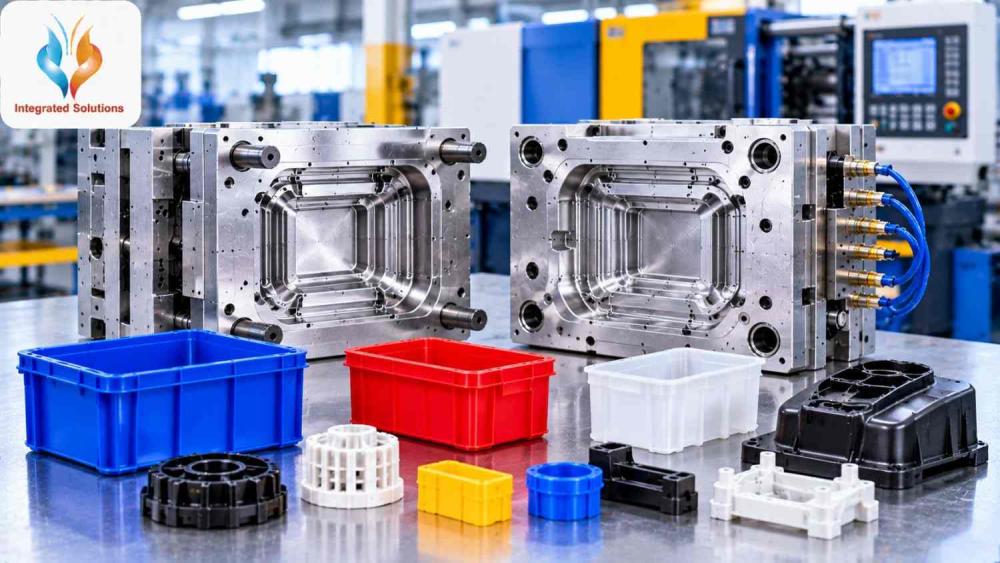
Plastic Mould Manufacturers and Their Role in Precision Engineering

A component passes initial inspection, but after several production cycles, its dimensions begin drifting. Assembly becomes difficult. Rejected parts accumulate, and the buyer starts questioning the tooling investment. Often, the problem begins with the Plastic Mould, not the moulding machine.
Precision engineering depends on more than accurate machining. Material behaviour, cavity design, cooling efficiency and process stability must work together. Experienced Plastic Mould manufacturers address these factors before production begins. Otherwise, a seemingly inexpensive tool can become an expensive manufacturing problem.
Plastic Mould Specifications That Determine Manufacturing Accuracy
A mould's engineering specifications influence part dimensions, surface finish, production consistency and maintenance requirements. Buyers should assess three critical areas before approving tooling.
Tool Steel, Cavity Configuration and Manufacturing Method
Plastic moulds commonly use hardened tool steels, pre-hardened steels or other suitable tooling materials, depending on production volume, polymer characteristics and operating conditions.
Single-cavity moulds suit lower output requirements, while multi-cavity configurations increase production capacity when properly balanced. Injection, blow and compression moulds serve different component designs and processing methods. For injection tooling, CNC machining and electrical discharge machining (EDM) help manufacture complex cavity profiles, inserts and detailed features.
Dimensional Tolerances and Shrinkage Allowances
A nominal dimension means little without an agreed tolerance and inspection method. ISO 20457:2026 addresses dimensional and geometrical tolerances for plastic moulded components. It recognises that polymer shrinkage, processing conditions and component geometry affect achievable accuracy.
Most buyers specify finished dimensions but overlook measurement conditions. A component measured immediately after moulding may behave differently after cooling and conditioning.
Cooling Channels, Gate Placement and Ejection
Uneven cooling can produce warpage, sink marks and dimensional variation. Poor gate placement may create filling problems or visible defects. Incorrect ejector positioning can damage finished surfaces.
Here's the difficult part: correcting these problems after tool manufacture may require expensive modifications.
Five Criteria for Evaluating Plastic Mould Manufacturers
Procurement teams should evaluate measurable capabilities rather than accept attractive presentations.
- Design validation: Request CAD drawings, design reviews and mould-flow assessment where appropriate. A bad answer is, "Our previous designs always work."
- Material traceability: Confirm the proposed tool steel grade, heat treatment and supporting records. "We use premium steel" without a grade or specification is not acceptable.
- Inspection capability: Ask how critical dimensions will be checked, including the measuring equipment and acceptance criteria. A supplier relying only on visual inspection is taking unnecessary risks.
- Tool trial documentation: Request trial samples, defect observations and corrective-action records. A supplier offering only photographs without dimensional evidence has not demonstrated precision.
- Maintenance and modification responsibility: Establish ownership of drawings, inserts, maintenance requirements and corrective work. "We'll handle issues later" is not a commercial agreement.
The cheapest quotation is rarely the cheapest tooling decision when corrections and production losses are ignored.
Six Benefits That Protect Production Margins
Precision-designed plastic moulds offer measurable operational advantages when the tooling and moulding process are properly controlled.
- Lower rejection rates: Stable cavity geometry and validated processing conditions reduce dimensional defects and material wastage.
- Predictable assembly: Controlled dimensions help components fit consistently, reducing manual adjustments and rework.
- Improved production efficiency: Effective cooling and ejection design can shorten unnecessary cycle delays without sacrificing part quality.
- Reduced maintenance interruptions: Suitable tool materials, wear-resistant features and accessible inserts simplify preventive maintenance.
- Better cost distribution: Properly designed multi-cavity tools can distribute tooling expenditure across more acceptable components.
- Reduced delivery risk: Documented tool trials and agreed inspection requirements help prevent quality disputes after dispatch.
None of these benefits is automatic. An eight-cavity tool producing inconsistent parts can be commercially worse than a properly validated four-cavity design.
Availability of Plastic Mould Manufacturers in India
India's industrial manufacturing network supports tooling requirements across automotive, packaging, electronics, consumer products and industrial equipment. For procurement teams evaluating Plastic Mould manufacturers in India, geographical access influences more than transportation charges. Engineering discussions, physical tool inspections and trial approvals become easier when suppliers operate near established manufacturing clusters.
Gurugram and the wider NCR industrial belt provide access to automotive and engineering supply chains. Gujarat also offers manufacturing infrastructure and industrial supplier networks. Integrated Solutions lists operating locations in Gurugram, Haryana, and the Ahmedabad region of Gujarat.
A nearby supplier, however, is not automatically a better supplier. Buyers should assess tool trial availability, technical communication, production scheduling and transportation responsibilities before making a decision. For geographically distant projects, clearly agreed sample approval and dispatch procedures become particularly important.
How We Approach Precision Tool Manufacturing at Integrated Solutions
At Integrated Solutions, we work across custom mould design, injection mould manufacturing, tooling development and precision engineering. We use CAD/CAM-based design methods and CNC and EDM machining for complex mould features. Our published capabilities include single-cavity and multi-cavity mould solutions, product development support and mould testing.
We understand that a finished mould and a production-ready mould are not necessarily the same thing.
That's why we consider trial runs, dimensional requirements and material suitability important parts of the tooling discussion. We also recognise that cooling behaviour and cavity balance cannot be judged from a polished mould surface alone. Our aim is to help buyers evaluate manufacturing requirements before committing to tooling expenditure.
At Integrated Solutions, we invite procurement managers, OEMs and product manufacturers to share their tooling requirements. Send us your 2D drawings or 3D CAD files, component dimensions, polymer grade, expected annual production quantity, cavity preference and required delivery location.
We respond to enquiries within 24 hours, as stated on our website. Our published standard mould lead-time guidance is 4–8 weeks, subject to design complexity. We do not publish one universal MOQ for custom tooling. We confirm applicable minimum quantities or project requirements during quotation.
Precision Begins Before the First Production Cycle
A well-engineered Plastic Mould protects product accuracy, production efficiency and long-term manufacturing expenditure. Buyers should prioritise documented specifications, meaningful tool trials and clearly assigned supplier responsibilities. The next generation of precision manufacturing will demand tighter coordination between product design, tooling engineering and production validation.
Frequently Asked Questions
1. What role does a Plastic Mould play in precision engineering?
It determines the component's cavity-defined geometry and influences dimensional consistency, surface appearance and repeatability. Final results also depend on polymer selection and processing conditions.
2. How do Plastic Mould manufacturers maintain dimensional accuracy?
They combine suitable tool design, precision machining, shrinkage allowances and sample inspection. Accuracy still needs verification under actual moulding conditions; machining precision alone is insufficient.
3. How should buyers compare Plastic Mould manufacturers in India?
Compare tooling materials, inspection facilities, trial procedures, technical documentation and modification terms. Geographic proximity helps communication, but it cannot replace demonstrated manufacturing capability.
4. Which materials are suitable for manufacturing plastic moulds?
Common choices include P20-type pre-hardened steels and hardened tool steels such as H13, depending on the application. The correct grade depends on the polymer, wear conditions, expected tool life and budget.
5. How long does custom plastic mould manufacturing take?
Integrated Solutions publishes a typical timeframe of 4–8 weeks for standard moulds. Complex tools may require longer, particularly when multiple trials or design modifications are needed.
6. Are multi-cavity plastic moulds always more economical?
No. Their advantage depends on production demand, cavity balance, tooling investment and acceptable part yield. For limited production volumes, a simpler tool may provide better economics.
7. What information should buyers provide before requesting a quotation?
Provide CAD drawings, component material, critical tolerances, annual volume, expected tool life and delivery requirements. Without these details, a quotation may exclude costly engineering work discovered later.


