








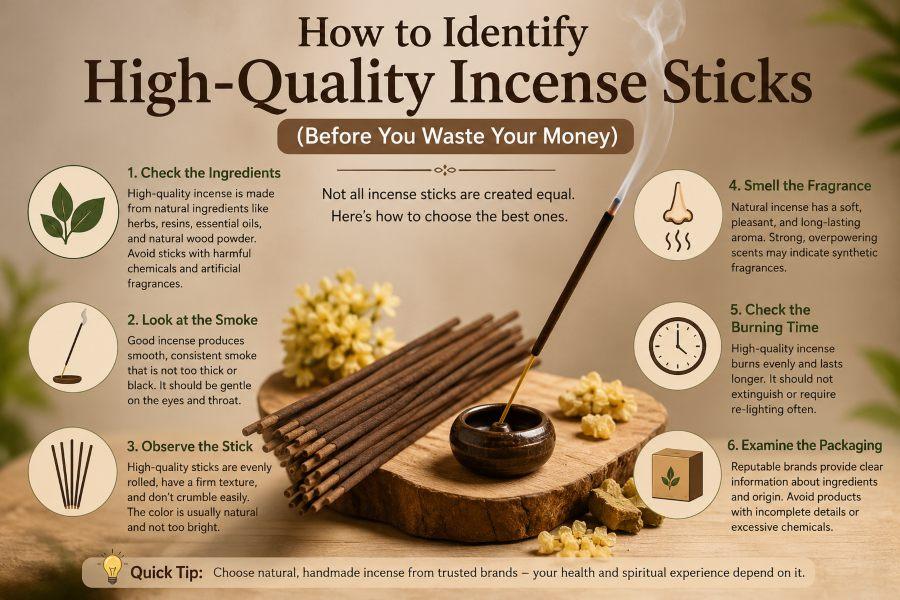
How to Identify High-Quality Incense Sticks

How to Identify High-Quality Incense Sticks (Before You Waste Your Money)
Ever lit an incense stick, waited for that calming fragrance to fill your room, and instead got a headache and a throat that felt like you'd swallowed sand? That's not a coincidence. It's chemistry — and usually bad chemistry. Most people buying incense sticks have no idea that the difference between a stick that deepens their meditation and one that gives them a sinus attack comes down to about five or six things you can check before you even light a match. If you've ever wondered why some sticks burn for an hour with a whisper of fragrance while others choke a room in ten minutes, you're about to find out. And if you want a source that already does this quality-checking for you, the ISKCON Mayapur Store has built its entire incense catalogue around traditional, temple-grade standards rather than mass-market shortcuts.
This isn't going to be a generic "sniff it and see" guide. We're going into the actual composition, the burning behavior, the packaging tells, and the sourcing questions that separate a genuinely good incense stick from a chemical stick dressed up in nice packaging.
Why Most Incense on the Market Is Actually Low Grade
Here's an uncomfortable truth: the incense industry has a transparency problem. Walk into almost any general store and you'll find sticks labeled "sandalwood" or "rose" that contain neither sandalwood nor rose — just synthetic fragrance oils dipped onto a bamboo core, sometimes with charcoal dust added to make the stick burn faster (which manufacturers like, because it means less raw material per stick).
The catch is that synthetic fragrance oils are usually built on a base of DEP (diethyl phthalate) or similar solvents to help the scent "throw" further. When burned, these compounds don't just smell different from natural resins — they behave differently in your lungs. That's the actual reason some incense gives people headaches and others don't.
None of this means incense is inherently bad for you. Traditionally made incense, using ground herbs, resins, and natural gums, has been burned in temples and homes for thousands of years without these complaints. The problem is scale. Once incense became a mass commodity, cost-cutting crept into the formula, and most buyers never learned what to look for.
The Five-Second Smell Test (And Why It's Not Enough)
Most people rely purely on smell, and honestly, it's a decent first filter — but it's incomplete.
- Natural incense tends to smell complex and slightly imperfect. Real sandalwood has a warm, woody, faintly sweet note that changes slightly as it burns.
- Synthetic incense smells too "clean" and one-dimensional, almost like air freshener. It hits you immediately and identically every time because it's the same lab-replicated molecule, batch after batch.
But here's what the smell test misses: you're smelling the unburned stick. A cheap stick can smell fantastic in the packet and turn acrid the moment you light it. This is why the real test has to include how it burns, not just how it smells sitting in a box.
What Actually Happens When You Burn It
This is where quality reveals itself, and it's the part most buying guides skip entirely.
Watch the Smoke, Not Just the Smell
Good incense sticks produce a thin, steady thread of smoke — almost delicate. Low-quality sticks, especially ones loaded with synthetic oil or excess charcoal, tend to billow out thick, dark smoke that clouds a room fast. Thick smoke usually means incomplete combustion, which is a sign of either poor-quality core material or an oil that isn't burning cleanly.
Notice the Ash
Traditional incense made with natural binders like gum arabic or makko powder leaves behind a fine, pale grey ash that curls or falls naturally. If the ash is dark, clumpy, or has an oily residue, that's often a red flag for added chemical accelerants.
Time the Burn
A quality stick usually burns for 35 to 50 minutes depending on length and thickness. If a stick burns out in 10-15 minutes, it likely has too much saltpetre or charcoal in the core — added purely to speed combustion and cut material costs, not to improve your experience.
Reading the Ingredient List Like Someone Who Knows What They're Looking For
Manufacturers aren't always required to disclose full ingredients, but reputable ones do — and that transparency itself is a quality signal. Here's what you actually want to see:
- Natural base materials: bamboo core (agarbatti style) or charcoal-free (dhoop/masala style) rolled from herbs, resins, and gums
- Named natural fragrance sources: sandalwood, agarwood (oudh), gugal, camphor, saffron — not just "sandalwood fragrance" which can legally mean a synthetic replica
- Natural binders: makko powder, gum arabic, or jigat powder rather than unnamed "binding agents"
What you want to be cautious of:
- Vague terms like "fragrance oil" or "aroma compound" with no origin specified
- Extremely long shelf-life claims (natural resin-based incense does age and can lose potency; a stick claiming years of shelf stability without any preservative disclosure is worth questioning)
- Unusually bright, uniform coloring — natural dyes from turmeric, sandalwood powder, or charcoal tend to look earthier and less uniform batch to batch
Where Sourcing Actually Matters (More Than Brand Names)
This is the part that surprises people: brand recognition means far less than sourcing discipline. A well-known brand can still cut corners if their supply chain isn't held to a consistent standard. What actually matters is whether the incense comes from a producer with a direct, traceable connection to temple or devotional use — because that context historically demanded higher purity, not lower.
Incense used in temple worship, for instance, has never been about mood-setting or air-freshening. It's offered as an act of devotion, meant to be inhaled during long hours of prayer and chanting, sometimes by people sitting in an enclosed space for extended periods. That practical requirement — sticks that could be burned for hours without harming the people breathing them in — pushed traditional producers toward cleaner formulations long before "clean living" became a marketing trend.
This is why sourcing from a devotional retail platform tends to be a safer bet than sourcing from a general gift shop. When you buy through a store built around temple use — sandalwood, gugal, camphor, and rose-based dhoop meant for daily puja — you're inheriting centuries of quality standards rather than a marketing department's guess at what "spiritual" should smell like.
A Quick Comparison: Reading the Signs at a Glance
|
What You're Checking |
High-Quality Sign |
Low-Quality Sign |
|
Smoke while burning |
Thin, steady stream |
Thick, dark, billowing |
|
Ash color |
Pale grey, fine |
Dark, clumpy, oily |
|
Burn time (standard stick) |
35–50 minutes |
Under 15 minutes |
|
Ingredient list |
Named natural resins, herbs |
Vague "fragrance" or "aroma" |
|
Scent evolution |
Changes subtly as it burns |
Identical from start to finish |
|
Coloring |
Earthy, slightly uneven |
Bright, perfectly uniform |
Storage: The Quality Factor Nobody Talks About
Even a genuinely well-made incense stick can degrade if stored badly, and this is where buyers unknowingly sabotage their own purchase.
- Humidity is the enemy. Natural resins absorb moisture from the air, which mutes fragrance and can cause uneven burning.
- Direct sunlight breaks down essential oils over time, which is why quality incense is almost always packaged in opaque or semi-opaque boxes rather than clear plastic.
- Store sticks upright or flat in their original box, away from bathrooms or kitchens where humidity spikes.
If you've ever bought incense that smelled incredible in the store and disappointing at home, storage conditions during transit and shelf time are often the real culprit — not necessarily the product itself.
Masala vs. Charcoal-Based: Which Should You Actually Choose?
This distinction gets glossed over constantly, but it changes your entire experience.
Charcoal-based (dipped) incense uses a charcoal or sawdust core dipped in fragrance oil. It's cheaper to produce and burns faster, which is why it dominates the budget market. Quality here depends almost entirely on the oil used.
Masala (rolled) incense, by contrast, is made by hand-rolling a paste of herbs, resins, and natural binders directly onto a bamboo stick — no dipping involved. This method tends to produce a subtler, longer-lasting, and more complex fragrance because the aromatic material is distributed through the entire stick rather than coated on the surface.
If you're using incense for meditation, prayer, or extended time in a room, masala-style sticks are generally the better long-term choice — they burn cleaner and don't rely on a solvent-heavy top coat to carry the scent.
The Question to Ask Before You Buy
If you take away only one habit from this, make it this question: "Can this seller tell me exactly what's in the stick, and why?"
A seller rooted in genuine devotional or traditional practice will usually answer without hesitation — they'll talk about sandalwood grade, resin origin, or why they use gugal instead of a synthetic musk substitute. A seller purely in it for margin often can't, because they themselves don't know past "fragrance oil, supplier X."
This single question filters out most of the low-quality market instantly, faster than any smell test or ash inspection ever could.
Bringing It All Together
Good incense isn't about the prettiest packaging or the most exotic-sounding scent name. It comes down to a handful of checkable, physical realities: how it smokes, how it burns, what's actually written on the ingredient list, and how it's been stored before it reached you. Once you know these markers, you'll never buy incense the old way again — sniffing a packet and hoping for the best.
If you'd rather skip the trial-and-error entirely, sourcing from a retailer with deep roots in devotional practice takes most of the guesswork out of the equation. Traditions built around daily worship never had room for shortcuts, and that discipline still shows up in the sticks themselves — cleaner smoke, longer burns, and fragrance that unfolds rather than overwhelms.


