








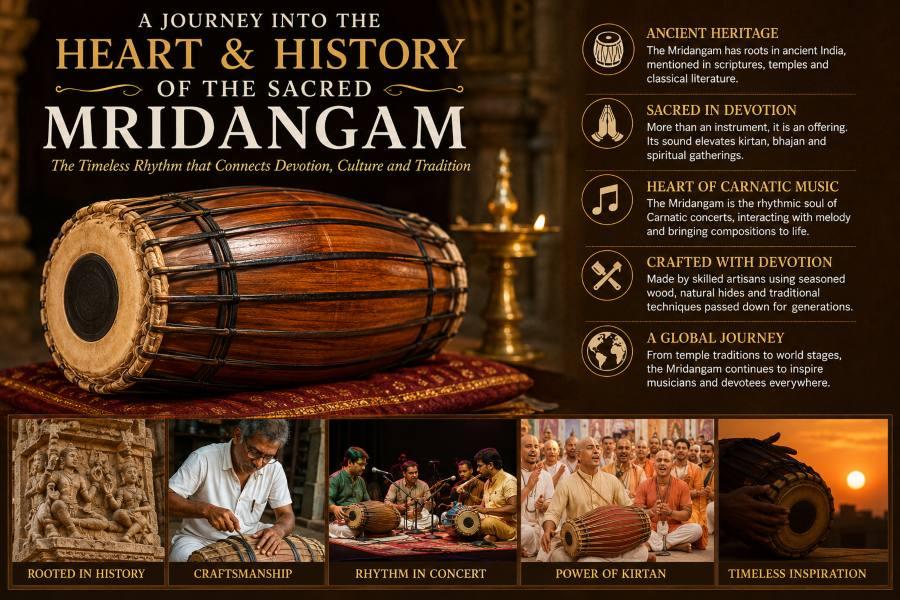
A Journey into the Heart and History of the Sacred Mridangam

A Journey into the Heart and History of the Sacred Mridangam
Imagine standing inside an ancient South Indian temple just before sunrise. Oil lamps flicker against stone walls darkened by centuries of devotion. The fragrance of sandalwood drifts through the air. A vocalist begins a prayer, and then a deep, resonant rhythm enters the space. The sound is neither loud nor aggressive, yet it immediately commands attention. That sound belongs to the Mridangam, an instrument that has shaped India's spiritual and musical traditions for generations.
Today, musicians, collectors, and devotional practitioners around the world seek authentic instruments through trusted sources such as the ISKCON Mayapur Online Store, helping preserve a tradition that stretches back hundreds of years. Yet the Mridangam is more than a musical instrument. It is a cultural treasure, a sacred companion in worship, and a living bridge connecting modern India with its ancient roots.
When a Drum Becomes More Than an Instrument
Most percussion instruments are designed with one purpose: keeping rhythm.
The Mridangam does far more than that.
For centuries, it has been viewed as an extension of devotional expression. In many spiritual communities, especially those connected with Vaishnava traditions, the instrument is treated with respect similar to that shown toward sacred objects used in worship.
Musicians often speak about the Mridangam in personal terms. They describe learning its rhythms not simply as musical training but as a discipline that shapes patience, concentration, humility, and awareness.
That relationship explains why the instrument continues to inspire such deep emotional attachment among performers.
Unlike modern electronic rhythm devices that can perfectly reproduce timing, the Mridangam carries something human within every stroke. Small variations in touch, pressure, and movement create a living rhythm that feels organic and expressive.
Perhaps that is why its sound remains timeless.
The Ancient Roots Hidden in Indian History
The story of the Mridangam begins long before concert halls, recording studios, and music festivals existed.
Historical evidence suggests that barrel-shaped drums resembling the modern Mridangam appeared in ancient India thousands of years ago. Temple sculptures, classical Sanskrit literature, and artistic depictions across South India reveal the instrument's deep historical presence.
The name itself offers a clue to its origins.
The word "Mridangam" is generally derived from Sanskrit:
- Mrid meaning earth or clay
- Anga meaning body
Early versions are believed to have been constructed from clay before wooden designs became more practical and durable.
Ancient Indian society placed tremendous value on music. Sound was not viewed merely as entertainment. It was understood as a medium capable of influencing consciousness and connecting individuals with the divine.
Within this worldview, rhythm held spiritual significance.
The Mridangam emerged as one of the primary instruments capable of expressing that rhythmic philosophy.
The Spiritual Connection That Never Faded
Many musical instruments rise and fall in popularity.
The Mridangam followed a different path.
Its survival was closely linked to religion, temple culture, and devotional practices. Because it served sacred functions, it remained relevant even during periods when artistic traditions faced challenges.
In South Indian temples, rhythm often accompanies prayer, chanting, dance, and ceremonial activities. The Mridangam became deeply woven into these practices.
Its sound carries a certain gravity.
Listeners frequently describe feeling grounded when they hear it.
This effect is not accidental.
The instrument's construction naturally produces rich low-frequency resonance alongside clear higher tones. Together they create a balanced sound that feels both energetic and calming.
For devotees engaged in kirtan or bhajan singing, the Mridangam helps maintain focus while encouraging collective participation.
Its rhythm creates unity.
Everyone follows the same pulse.
Everyone moves together.
That shared experience is part of what gives devotional music its power.
The Craftsmanship Behind Every Great Mridangam
A masterfully built Mridangam represents years of accumulated knowledge.
Creating one is neither simple nor quick.
Traditional artisans spend significant time selecting appropriate wood. Jackfruit wood remains one of the most respected choices because of its tonal qualities and durability.
The process often includes:
- Selecting seasoned wood
- Carving a balanced hollow shell
- Shaping both sides precisely
- Preparing multiple layers of drumhead material
- Applying specialized tuning compounds
- Fine-tuning resonance characteristics
Every stage influences the final sound.
A minor adjustment in thickness can dramatically alter tonal response.
This is why handcrafted instruments continue to command respect among serious musicians.
Machine production can replicate appearance.
It cannot easily reproduce decades of experience held by skilled artisans.
Each high-quality Mridangam carries evidence of that craftsmanship.
Why Carnatic Music Depends on the Mridangam
To understand the importance of the Mridangam, one must understand its role in Carnatic music.
Carnatic music is among the world's most sophisticated classical traditions. Its rhythmic systems are extraordinarily detailed, often involving mathematical structures that challenge even experienced performers.
At the center of this rhythmic universe sits the Mridangam.
Yet describing it merely as an accompanying instrument would be misleading.
A skilled Mridangam artist actively participates in the performance.
The instrument responds to:
- Vocal improvisations
- Instrumental phrases
- Tempo changes
- Emotional shifts
- Rhythmic developments
The result feels like a conversation rather than accompaniment.
When a vocalist introduces a complex phrase, the Mridangam responds intelligently.
When tension builds, the percussion can amplify that energy.
When the music softens, the rhythm adapts gracefully.
This interactive role explains why accomplished Mridangam players are so highly respected within Carnatic circles.
The Fascinating Science of Its Sound
Few listeners realize how sophisticated the acoustics of the Mridangam truly are.
The instrument contains two drumheads positioned on opposite ends of a single barrel-shaped body.
One side typically produces lower frequencies.
The other generates brighter, higher-pitched tones.
Because both heads share the same resonating chamber, they interact acoustically.
This interaction produces a unified tonal character that differs significantly from many other percussion instruments.
The sound feels connected.
Bass and treble seem to belong to the same voice.
Modern acoustic studies have examined the harmonic properties of Indian percussion instruments and repeatedly highlighted their remarkable engineering.
Long before scientific measurement tools existed, traditional craftsmen had already developed methods capable of producing sophisticated tonal behavior.
That achievement deserves admiration.
Learning the Mridangam Is a Journey of Character
Many beginners underestimate what it takes to become proficient on the instrument.
The challenge extends beyond rhythm.
Students must develop:
- Hand coordination
- Finger strength
- Listening ability
- Timing accuracy
- Musical memory
- Physical endurance
Progress occurs gradually.
The first months often focus on fundamental strokes.
Only later do students begin exploring advanced rhythmic combinations.
This process teaches patience.
There are no shortcuts.
Every improvement reflects consistent effort.
For this reason, many teachers believe Mridangam training offers lessons that extend beyond music itself.
The discipline learned through practice often influences other areas of life, including concentration, work ethic, and self-control.
The Mridangam's Place in Devotional Traditions
Outside classical music, the Mridangam plays a vital role in devotional communities across India and beyond.
Kirtan traditions particularly embrace the instrument.
Its rhythmic energy helps guide collective chanting while supporting singers and participants.
Within Vaishnava communities, the instrument often accompanies:
- Harinam Sankirtan
- Temple worship
- Festival celebrations
- Bhajan gatherings
- Spiritual retreats
The sound becomes part of the devotional atmosphere itself.
Many practitioners associate specific rhythms with cherished spiritual memories.
A single rhythmic pattern can instantly evoke recollections of festivals, pilgrimages, and moments of collective worship.
That emotional connection explains why the instrument remains deeply loved by generations of devotees.
The Masters Who Turned Rhythm Into Art
Every great tradition survives because a few extraordinary individuals dedicate their lives to preserving and advancing it. The history of the Mridangam is filled with such figures.
Across generations, legendary performers transformed what audiences thought was possible on the instrument. Their innovations expanded technique, refined tonal quality, and introduced new approaches to rhythmic expression without abandoning traditional foundations.
What makes these masters remarkable is that they rarely viewed themselves as solo stars. Most saw their role as serving the music itself.
This philosophy remains central to Mridangam culture today.
A great Mridangam artist does not attempt to overpower the vocalist or instrumentalist. Instead, they elevate the entire performance. The best players create moments where rhythm feels inseparable from melody.
Students often spend years studying recordings of renowned performers, not merely to imitate their techniques but to understand how they think musically.
That tradition of learning through observation continues to keep the art form vibrant.
Inside the Temple: Where Rhythm Meets Worship
The sacred reputation of the Mridangam cannot be separated from its presence in temples.
For centuries, devotional music has served as an offering rather than entertainment. In many South Indian traditions, music is considered a form of worship, and the instruments used in that worship carry symbolic importance.
When a Mridangam accompanies devotional singing, it becomes part of a spiritual experience shared between musicians, devotees, and the Divine.
The rhythm creates structure.
The structure creates focus.
That focus allows participants to become fully immersed in prayer and chanting.
Temple musicians often speak about playing with a different mindset than they would during a public concert. Technical excellence remains important, but devotion becomes equally significant.
This combination of artistry and spirituality gives the instrument a unique identity.
Very few percussion instruments in the world occupy such a role.
Why the Mridangam Became the Soul of Kirtan
Kirtan is built upon participation.
Unlike many forms of classical performance where audiences primarily observe, kirtan encourages everyone to join through singing, clapping, and chanting.
The Mridangam helps make this possible.
Its rhythmic pulse guides the group while creating momentum that sustains collective energy. A skilled player knows when to increase intensity, when to simplify patterns, and when to create space for voices to shine.
This balance is essential.
If the rhythm becomes too complex, participants may lose connection.
If it becomes too repetitive, energy can fade.
The Mridangam occupies the perfect middle ground.
Its rich sound cuts through large gatherings while remaining warm and inviting.
This explains why it remains one of the most beloved instruments in devotional music around the world.
From India to Every Continent
A century ago, hearing a Mridangam outside India would have been uncommon.
Today, the situation looks dramatically different.
Global interest in yoga, meditation, kirtan, and Indian classical music has introduced the instrument to audiences across Europe, North America, South America, Africa, and Australia.
International festivals regularly feature Mridangam performances.
Music schools outside India now offer instruction.
Online lessons connect students with teachers regardless of geography.
The instrument's growth reflects something deeper than cultural curiosity.
People respond to authenticity.
The Mridangam carries centuries of tradition while remaining relevant to modern listeners. Its rhythms feel ancient and contemporary at the same time.
That combination continues attracting new generations of musicians.
The Role of the Mridangam in ISKCON and Global Bhakti Culture
One of the most significant factors behind the worldwide spread of the Mridangam has been the growth of Krishna bhakti communities.
Within the International Society for Krishna Consciousness, commonly known as ISKCON, the instrument occupies a central role in congregational chanting.
Walk into an ISKCON temple almost anywhere in the world and there is a strong chance you will hear the familiar sound of the Mridangam accompanying the Hare Krishna maha-mantra.
Its presence extends beyond temples.
The instrument appears during:
- Street kirtans
- Spiritual retreats
- Festivals
- Youth gatherings
- Cultural programs
- Educational workshops
Many devotees choose to learn the instrument because it allows them to actively participate in devotional service.
In this way, the Mridangam functions not only as a musical tool but also as a vehicle for spiritual engagement.
Choosing an Authentic Mridangam
For serious students and collectors, selecting the right instrument is an important decision.
Not all Mridangams are created equal.
An authentic, well-crafted instrument should offer:
- Balanced tonal response
- Stable tuning characteristics
- Durable construction
- Comfortable playability
- Consistent resonance
Several factors deserve careful attention.
Wood Quality Matters
The shell forms the foundation of the instrument's sound.
Seasoned jackfruit wood remains highly respected because it provides warmth, durability, and tonal richness.
Craftsmanship Makes the Difference
The finest instruments reflect the experience of skilled artisans.
Small details influence everything from projection to sustain.
Sound Should Feel Alive
A quality Mridangam responds naturally to touch.
The instrument should not feel restricted or lifeless.
Even simple strokes should reveal depth and character.
Investing in quality often saves money over time because a well-built instrument can provide decades of reliable performance.
The Digital Age Could Not Replace It
Many traditional instruments have struggled in the face of modern technology.
The Mridangam has proven remarkably resilient.
Digital rhythm machines can imitate patterns.
Software can reproduce timing.
Artificial sounds can approximate percussion.
Yet none of these alternatives fully capture the organic interaction between performer and instrument.
The subtle variations created by human touch remain impossible to replicate perfectly.
Listeners notice the difference, even if they cannot explain it technically.
This reality has helped preserve demand for authentic instruments and live performance.
Technology has changed how people learn and share music, but it has not diminished the value of the Mridangam itself.
If anything, digital platforms have introduced the instrument to larger audiences than ever before.
Why the Mridangam Continues to Inspire Future Generations
Every musical tradition faces a simple question: can it remain meaningful to younger generations?
The Mridangam continues to answer with a resounding yes.
Young musicians are discovering that rhythm offers endless possibilities for creativity. At the same time, spiritual communities continue introducing the instrument to new practitioners seeking deeper engagement with devotional music.
The instrument appeals to both artistic and spiritual aspirations.
Some students are fascinated by its mathematical sophistication.
Others are drawn to its devotional associations.
Many appreciate both.
This broad appeal helps explain why the tradition remains healthy despite rapid cultural change.
More Than History, More Than Music
The story of the Mridangam is not merely about percussion.
It is a story about continuity.
Generations of artisans preserved its construction methods. Teachers preserved its techniques. Devotees preserved its spiritual role. Musicians preserved its artistic excellence.
Together, they ensured that the instrument never became a museum artifact.
Instead, it remains a living tradition.
Every performance adds another chapter.
Every student carries the legacy forward.
Every rhythm connects the present with the past.
Final Thoughts
The Mridangam stands among India's most remarkable cultural achievements. It combines craftsmanship, spirituality, mathematics, artistry, and history within a single instrument. Few musical traditions possess an object capable of carrying so many layers of meaning.
Its sound has echoed through temples, concert halls, village gatherings, royal courts, devotional processions, and international festivals. Through centuries of social change, technological advancement, and shifting musical trends, the Mridangam has retained its identity.
That enduring presence explains why the instrument continues to command such respect. It is not simply a drum. It is a symbol of living heritage, a companion to devotion, and one of the most profound rhythmic voices ever created.
For anyone seeking to understand Indian music at its deepest level, the journey eventually leads to the same place—the resonant, timeless heartbeat of the Mridangam.


