








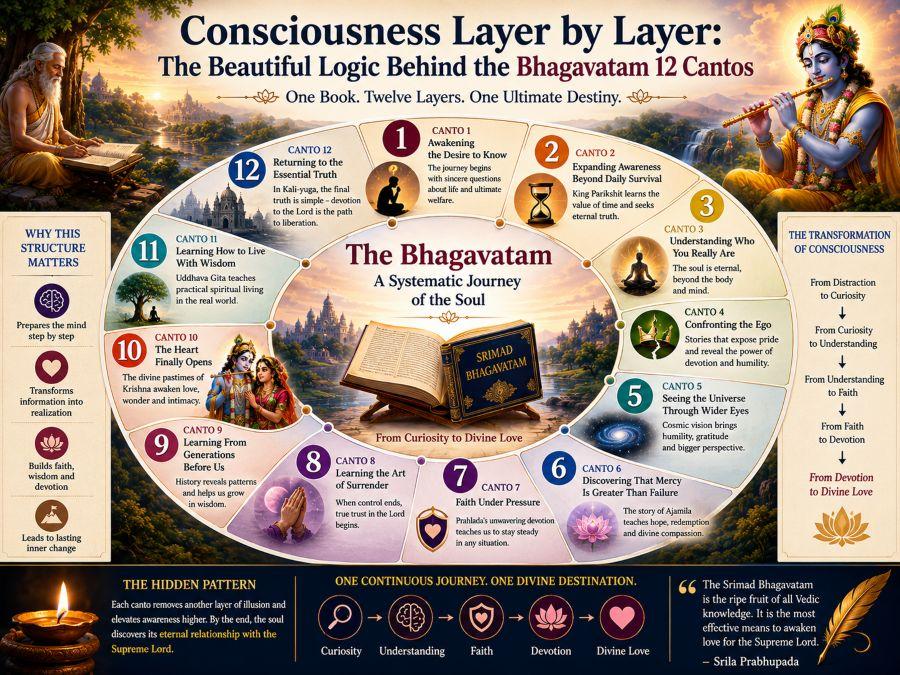
The Beautiful Logic Behind the Bhagavatam 12 Cantos

Consciousness Layer by Layer: The Beautiful Logic Behind the Bhagavatam 12 Cantos
What if the greatest spiritual book ever written was not simply a collection of stories, but a carefully engineered journey through the human mind?
Imagine entering a magnificent temple. You don't immediately reach the innermost sanctuary. You pass through gateways, courtyards, pillars, and sacred chambers. Each step prepares you for the next. By the time you arrive at the center, your state of mind has already changed.
That is exactly how the srimad bhagavatam operates.
Many readers approach the Bhagavatam expecting mythology, philosophy, or religious instruction. What they often discover is something far more sophisticated. The twelve cantos are arranged with remarkable precision. Each canto addresses a particular layer of consciousness, gradually elevating the reader from ordinary material thinking to the highest understanding of divine love.
Nothing is random.
The order matters.
The progression matters.
The emotional journey matters.
The Bhagavatam does not merely provide information about God. It systematically transforms the way a person sees themselves, others, the world, and ultimately the Supreme Lord.
Understanding this hidden structure reveals why the text has remained spiritually relevant for centuries.
The Bhagavatam Is Built Like a Staircase, Not an Encyclopedia
Many sacred texts can be studied by jumping from one section to another.
The Bhagavatam invites a different approach.
Think of it as a staircase with twelve levels.
Each step creates a specific shift in consciousness.
If someone begins reading the Tenth Canto without understanding the foundation established by the previous cantos, they may enjoy the stories but miss much of their deeper significance.
The Bhagavatam assumes something very important:
Before divine love can fully awaken, the mind must be prepared.
Human consciousness develops in stages.
A person first becomes curious.
Then they seek understanding.
Then they question assumptions.
Then they gain perspective.
Then faith grows.
Then devotion matures.
Then love blossoms.
The twelve cantos mirror this exact process.
Layer One: Awakening the Desire to Know
Why the First Canto Starts With Questions
Most people spend their lives searching for answers.
Few spend enough time examining their questions.
The First Canto begins with sages gathered at Naimisharanya asking profound questions about life, purpose, and ultimate welfare.
This is not accidental.
The Bhagavatam understands that transformation begins with inquiry.
Without inquiry:
- Knowledge becomes superficial.
- Spirituality becomes ritualistic.
- Faith becomes mechanical.
The first canto encourages readers to pause and ask:
- Why am I here?
- What is permanent?
- What creates genuine happiness?
- What remains valuable at the time of death?
The first layer of consciousness shifts from distraction to curiosity.
That shift changes everything.
Layer Two: Expanding Awareness Beyond Daily Survival
The Perspective That Changes Priorities
The Second Canto introduces King Parikshit, who learns he has only seven days left to live.
Suddenly, ordinary concerns lose their importance.
This scenario serves an important psychological purpose.
Most people live as if time is endless.
The Bhagavatam gently challenges that illusion.
When mortality becomes visible, consciousness expands.
Questions change.
Priorities change.
Behavior changes.
The reader begins realizing:
- Temporary achievements have limits.
- Spiritual development cannot be postponed forever.
- Life gains meaning when viewed through eternity.
This canto stretches consciousness beyond immediate concerns and short-term desires.
Layer Three: Understanding Who You Really Are
The Difference Between Identity and Illusion
Modern society encourages people to define themselves through external labels.
Career.
Status.
Nationality.
Appearance.
Social position.
The Third Canto introduces a radical idea.
You are not merely the body.
You are not merely the mind.
You are an eternal spiritual being.
Through the teachings of Lord Kapila, readers learn about:
- Consciousness
- Material nature
- Karma
- Attachment
- Liberation
This creates one of the most important mindset shifts in the entire Bhagavatam.
When identity changes, perception changes.
When perception changes, behavior changes.
The Bhagavatam understands that spiritual growth begins when individuals stop seeing themselves exclusively through material categories.
Layer Four: Confronting the Ego
Why Growth Requires Humility
Every person possesses an ego.
The question is whether the ego serves truth or distorts it.
The Fourth Canto presents stories that expose both the danger of pride and the power of devotion.
Daksha represents arrogance.
Dhruva represents transformation.
Dhruva initially seeks spiritual practice for material reasons.
He wants recognition.
He wants validation.
He wants status.
His journey mirrors the path many people unknowingly follow.
Yet something remarkable happens.
As his consciousness evolves, his desires evolve.
By the time he encounters the Lord, his original ambitions seem insignificant.
The lesson is profound.
Spiritual growth is not about suppressing desire.
It is about refining desire.
Layer Five: Seeing the Universe Through Wider Eyes
Why Perspective Reduces Anxiety
Many forms of suffering become stronger when a person's focus becomes excessively narrow.
Small problems feel enormous when viewed in isolation.
The Fifth Canto expands consciousness dramatically.
Its descriptions of cosmic systems remind readers that existence is vast beyond imagination.
Some readers focus exclusively on the cosmology.
The deeper lesson lies elsewhere.
The canto encourages humility.
When people understand they are part of a much larger reality:
- Anxiety decreases.
- Perspective increases.
- Gratitude grows.
- Self-centered thinking weakens.
The story of King Bharata reinforces another lesson.
Even advanced spiritual practitioners must remain attentive.
Consciousness is shaped by where attention goes.
Layer Six: Discovering That Mercy Is Greater Than Failure
The Psychology of Redemption
Many people secretly carry emotional burdens from the past.
Regret.
Guilt.
Shame.
Poor decisions.
The Sixth Canto introduces one of the Bhagavatam's most hopeful themes.
No one is beyond redemption.
The story of Ajamila demonstrates that divine compassion exceeds human expectations.
This canto transforms consciousness by replacing despair with possibility.
Readers begin understanding:
- Past mistakes do not define future potential.
- Spiritual progress can restart at any moment.
- Mercy remains available even after failure.
The mind becomes lighter when it stops identifying entirely with its worst moments.
Layer Seven: Faith Under Pressure
Why Easy Faith Is Not Enough
Faith is simple when circumstances are favorable.
The real test appears during adversity.
The Seventh Canto introduces Prahlada Maharaja, whose devotion remains unshaken despite intense opposition.
Prahlada represents a higher layer of consciousness.
His faith does not depend on external comfort.
His conviction does not depend on social approval.
His devotion does not depend on personal gain.
This canto teaches an important truth:
Spiritual maturity is revealed during difficulty, not convenience.
Readers begin developing resilience rather than conditional belief.
Layer Eight: Learning the Art of Surrender
What Happens When Control Ends
Human beings naturally seek certainty.
Life rarely provides it.
The Eighth Canto repeatedly places its characters in situations where personal power reaches its limit.
Gajendra's prayer remains one of the most moving examples.
After exhausting every available option, he turns completely toward the Lord.
This is not passive surrender.
It is intelligent surrender.
The Bhagavatam distinguishes between helplessness and trust.
One is weakness.
The other is strength.
Readers gradually learn that not everything can be controlled, but everything can be spiritually navigated.
Layer Nine: Learning From Generations Before Us
History as a Mirror
The Ninth Canto explores royal dynasties and historical lineages.
Some readers initially wonder why these accounts matter.
The answer becomes clear when viewed through the lens of consciousness.
History reveals recurring patterns.
Human beings repeatedly struggle with:
- Ambition
- Responsibility
- Attachment
- Leadership
- Desire
The Bhagavatam uses history as a classroom.
Readers learn through the successes and failures of others rather than repeating every mistake personally.
This layer develops wisdom.
Wisdom often arrives through observation before experience.
Layer Ten: The Heart Finally Opens
Why the Tenth Canto Feels Different
Everything leading up to this point prepares the reader for the Tenth Canto.
The mood changes noticeably.
Earlier cantos educate.
The Tenth Canto captivates.
Readers encounter the beautiful pastimes of Lord Krishna.
Something significant happens here.
The relationship with the Divine becomes personal.
The Lord is no longer understood only through philosophy.
He becomes:
- Friend
- Son
- Protector
- Beloved
- Companion
This canto addresses the deepest layer of consciousness: the heart.
Knowledge informs.
Love transforms.
The Bhagavatam ultimately seeks transformation.
That is why the Tenth Canto occupies such a central position.
Layer Eleven: Learning How to Live With Wisdom
Bringing Spiritual Insight Into Daily Life
Powerful experiences alone do not create lasting change.
They must be integrated into everyday living.
The Eleventh Canto provides exactly that guidance.
The Uddhava Gita offers practical wisdom for maintaining spiritual consciousness in a complex world.
Readers learn:
- Detachment without indifference.
- Responsibility without obsession.
- Devotion without fanaticism.
- Wisdom without pride.
This canto acts as a bridge between spiritual realization and practical life.
The teachings become applicable rather than theoretical.
Layer Twelve: Returning to the Essential Truth
The Final Layer of Consciousness
The Twelfth Canto examines the characteristics of Kali-yuga.
Its descriptions often feel surprisingly familiar.
Materialism increases.
Distraction increases.
Authenticity decreases.
Yet the Bhagavatam does not end with pessimism.
It ends with clarity.
After traveling through twelve layers of consciousness, the reader arrives at a simple realization:
The soul's deepest fulfillment comes through loving connection with the Supreme Lord.
Everything else supports that understanding.
Nothing else replaces it.
The Hidden Pattern Running Through All Twelve Cantos
When viewed together, the cantos reveal an elegant progression:
- Curiosity awakens.
- Perspective expands.
- Identity clarifies.
- Ego softens.
- Awareness broadens.
- Mercy inspires hope.
- Faith strengthens.
- Trust deepens.
- Wisdom develops.
- Love awakens.
- Understanding matures.
- Truth becomes clear.
This sequence mirrors authentic spiritual growth.
The Bhagavatam does not ask readers to leap immediately into advanced realization.
It guides them step by step.
Each canto solves a different problem within consciousness.
Each canto prepares the foundation for the next.
Why This Structure Still Matters Today
Modern people possess unprecedented access to information.
Knowledge is everywhere.
Wisdom remains rare.
The Bhagavatam recognizes that information alone cannot transform a person.
Transformation requires:
- Reflection
- Experience
- Emotional engagement
- Spiritual insight
The twelve-canto structure provides all four.
Readers are not merely informed about spiritual truths.
They gradually begin experiencing them internally.
That is why the Bhagavatam continues influencing hearts centuries after its composition.
Its teachings address timeless aspects of human nature.
The outer world changes.
The inner search remains the same.
Final Thoughts: One Book, Twelve Layers, One Ultimate Destination
The Srimad Bhagavatam is often described as the ripened fruit of Vedic wisdom. Yet that description only hints at its brilliance.
Beneath its stories, prayers, philosophies, and historical accounts lies a carefully designed progression of consciousness.
Each canto removes another layer of illusion.
Each canto elevates awareness slightly higher.
Each canto prepares the reader for deeper realization.
By the end of the journey, the transformation is unmistakable.
The reader who began with curiosity now possesses perspective.
The reader who sought information now seeks devotion.
The reader who identified with temporary labels begins recognizing an eternal spiritual identity.
That is the beautiful logic behind the Bhagavatam's twelve cantos.
Twelve sections.
One continuous journey.
One systematic elevation of consciousness.
One invitation to discover the soul's eternal relationship with the Supreme Lord.


